
Your website is only as powerful as the words on it. If you have been searching for a web page content writer because your site is not bringing in the leads, the traffic, or the customers you were expecting, you are in the right place. Great website content does not happen by accident — it is planned, researched, and written with a clear purpose. This guide walks you through everything a small business owner needs to know about working with a professional web page content writer, developing a content strategy that Google rewards, and building a system that produces consistent, high-quality results without consuming all of your time.
Whether you are building your first business website, refreshing outdated copy, or trying to understand why your competitors are ranking above you on Google, the answers all come back to content. The pages you publish, the keywords you target, and the structure you follow determine how visible your business is to the people actively searching for what you offer. By the time you finish reading, you will have a clear, step-by-step understanding of how professional website content writing works and exactly what you can do to make it work for your business.
Introduction: Why Every Small Business Needs a Web Page Content Writer
If you have ever searched for a web page content writer, you already understand the core problem: your website needs words that actually do something. Not just filler text. Not just a paragraph lifted from your brochure. Real, strategic, search-engine-optimized content that draws people in, keeps them reading, and turns them into paying customers.
The truth is that most small business owners set up a website, add a few pages, and then wait for Google to do its job. Weeks pass. Then months. The phone does not ring the way they hoped. The online enquiries trickle in slowly, if at all. What went wrong? In almost every case, the answer is the same: the content on those pages was never written to rank.
That is where a skilled web page content writer makes all the difference. A professional content writer does not simply fill space on a screen. They research your audience, map your keywords, craft compelling copy, and structure every paragraph in a way that Google’s algorithm rewards. The result is website content that works around the clock, attracting the right visitors and converting them into leads.
This guide is written specifically for small business owners who want to understand exactly what web page content writing involves, why it matters for SEO, and how to either hire the right person or follow a reliable system to create content that climbs search rankings. Every section breaks down a core concept in plain language so you can take immediate, informed action.
Quick Fact: According to a 2026 study by Semrush, websites that publish consistent, high-quality content generate up to 3.5 times more organic traffic than those that do not. Content is not a luxury — it is the engine of your online growth.
What Does a Web Page Content Writer Actually Do?
Before you can decide whether to hire a web page content writer, use a content service, or develop a writing workflow of your own, you need to understand what the role actually involves. Many business owners assume that writing is writing — that any talented wordsmith can produce website copy. In reality, web page content writing is a specialized discipline that sits at the intersection of copywriting, search engine optimization, audience psychology, and digital marketing strategy.
The Core Responsibilities of a Web Page Content Writer
A professional web page content writer brings a structured, multi-stage process to every page they create. Rather than opening a blank document and typing whatever comes to mind, an experienced writer works through a defined workflow that ensures every piece of content serves both the reader and the search engine. The following steps represent what a quality content creation process looks like in practice.
-
-
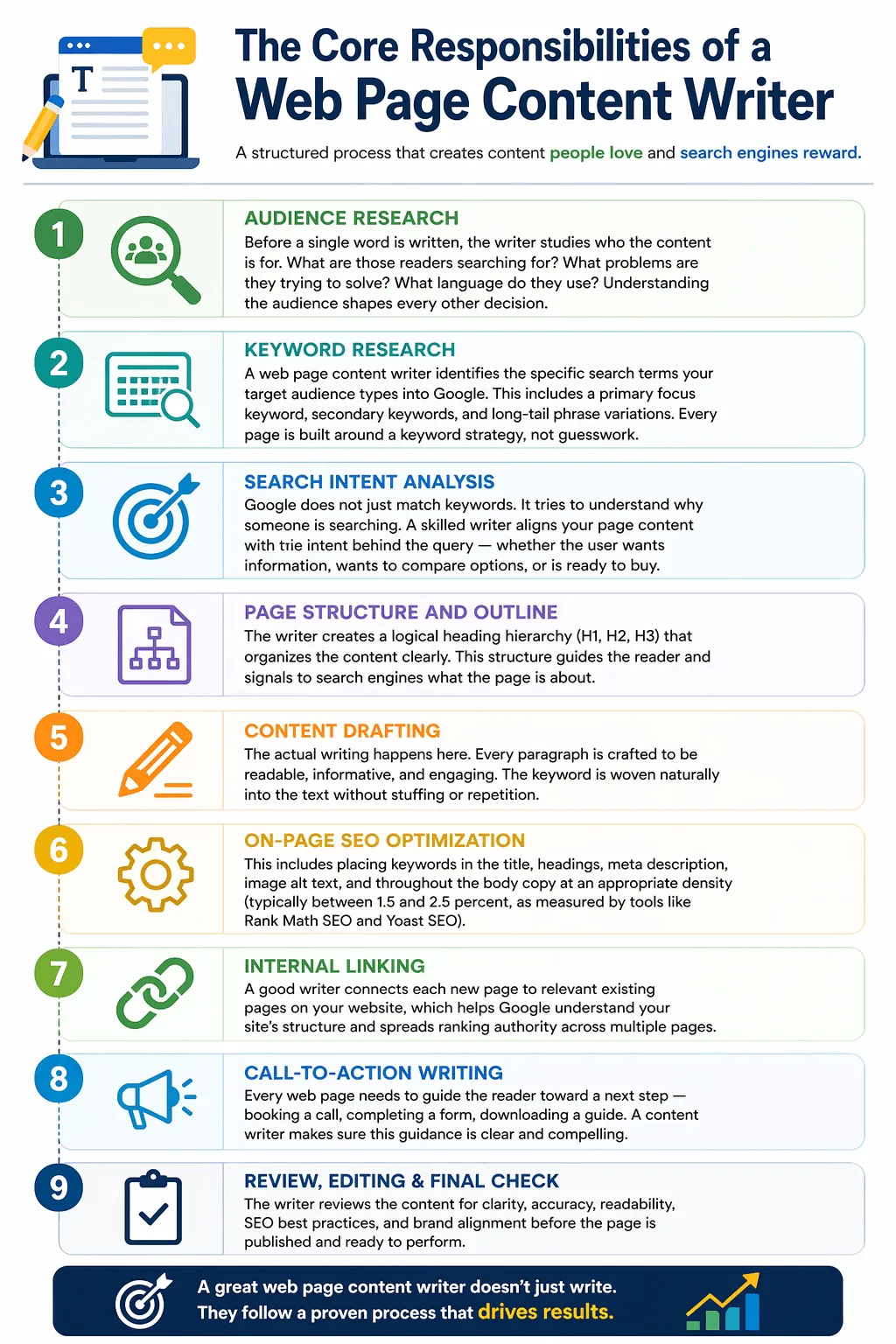
- Audience Research – Before a single word is written, the writer studies who the content is for. What are those readers searching for? What problems are they trying to solve? What language do they use? Understanding the audience shapes every other decision.
- Keyword Research – A web page content writer identifies the specific search terms your target audience types into Google. This includes a primary focus keyword, secondary keywords, and long-tail phrase variations. Every page is built around a keyword strategy, not guesswork.
- Search Intent Analysis – Google does not just match keywords. It tries to understand why someone is searching. A skilled writer aligns your page content with the intent behind the query — whether the user wants information, wants to compare options, or is ready to buy.
- Page Structure and Outline – The writer creates a logical heading hierarchy (H1, H2, H3) that organizes the content clearly. This structure guides the reader and signals to search engines what the page is about.
- Content Drafting – The actual writing happens here. Every paragraph is crafted to be readable, informative, and engaging. The keyword is woven naturally into the text without stuffing or repetition.
- On-Page SEO Optimization – This includes placing keywords in the title, headings, meta description, image alt text, and throughout the body copy at an appropriate density (typically between 1.5 and 2.5 percent, as measured by tools like Rank Math SEO and Yoast SEO).
- Internal Linking – A good writer connects each new page to relevant existing pages on your website, which helps Google understand your site’s structure and spreads ranking authority across multiple pages.
- Call-to-Action Writing – Every web page needs to guide the reader toward a next step — booking a call, completing a form, downloading a guide. A content writer makes sure this guidance is clear and compelling.
-
Understanding this full scope helps you see why handing writing to a non-specialist often produces thin, unranked content. A web page content writer is not simply a typist — they are a strategic contributor to your business growth.
Why Website Content Writing Is the Foundation of Small Business SEO
Search engine optimization is often described in technical terms — algorithms, backlinks, Core Web Vitals, schema markup. While all of those things matter, none of them deliver results without strong underlying content. In 2026, Google’s ranking systems are more sophisticated than ever, and the one factor that continues to drive ranking success above everything else is the quality, depth, and relevance of the content on your pages.
According to research published by Backlinko, the average page that ranks number one on Google also ranks in the top ten results for nearly one thousand other related keywords. That is not an accident. That is the result of well-written, comprehensive content that naturally covers a topic with authority and depth. A skilled web page content writer creates exactly this kind of content.
How Google Evaluates Website Content in 2026
Google’s Helpful Content system, which was significantly updated between 2023 and 2025, now places enormous weight on what it calls E-E-A-T: Experience, Expertise, Authoritativeness, and Trustworthiness. Understanding these four signals is essential for any small business owner working with a web page content writer or producing content independently. Each of these qualities can be demonstrated through the way your content is written and structured.
-
-
- Experience – Google wants to see content written by people who have real, first-hand knowledge of the subject. This means including practical examples, real-world scenarios, and specific details that only someone with genuine experience would know.
- Expertise – Your content should demonstrate subject matter knowledge. A plumber writing about boiler maintenance should include technical detail. A nutritionist writing about meal planning should reference evidence-based guidelines. Depth signals expertise.
- Authoritativeness – Over time, Google measures how other websites and users respond to your content. Are people linking to it? Are they staying on the page and reading through? Is the website consistently producing quality material on a specific topic?
- Trustworthiness – This includes clear authorship, accurate information, honest claims, and a website that is technically secure and properly maintained. Trust is the foundation of all other signals.
-
A professional web page content writer incorporates all four E-E-A-T signals naturally into every piece of content they produce. They write with authority, cite credible sources, structure information clearly, and make every claim they write easy to verify. For small businesses, this approach is not just good writing practice — it is an essential competitive strategy.
Industry Insight: Seventy-four percent of small businesses plan to invest in SEO in 2026, according to research by Content Whale. With competition increasing, content quality is no longer a differentiator — it is the baseline requirement for visibility.
The Types of Web Page Content That Every Small Business Website Needs
Not all web pages serve the same purpose, and a skilled web page content writer understands that each type of page requires a different approach, tone, and structure. One of the most common mistakes small business owners make when building their websites is treating all pages the same. A homepage is not a blog post. A services page is not an about page. Each page type has a specific role in your overall digital marketing strategy, and content must be crafted accordingly.
Homepage Content
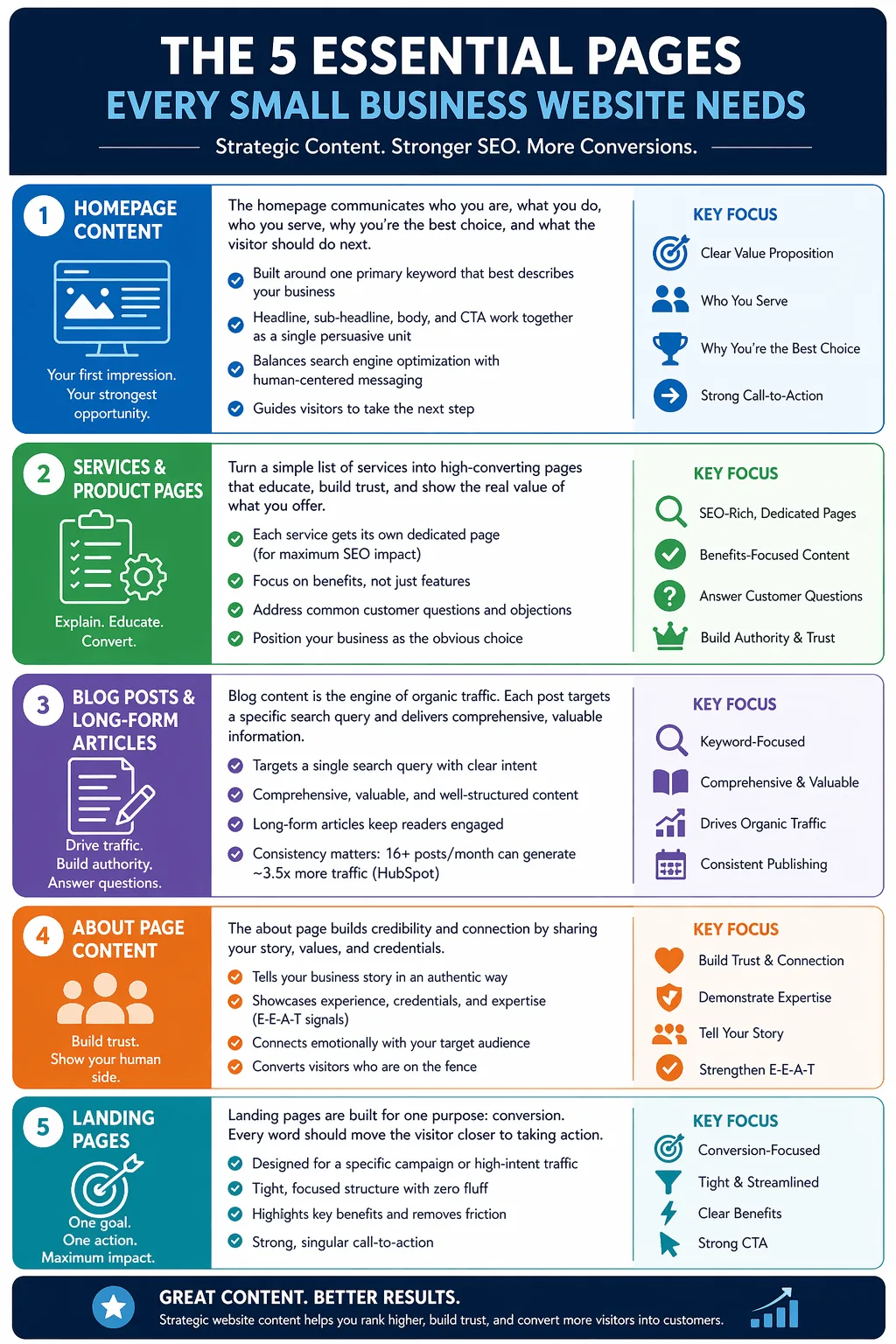
Your homepage is the most visited page on your website and the first impression most potential customers will have of your business. The content here needs to do several things simultaneously: communicate what you do, who you serve, why you are the best choice, and what the visitor should do next. A web page content writer approaches the homepage by identifying the primary keyword that best describes your business, and building the entire page around a message that is both search-engine-friendly and human-centered. The headline, sub-headline, body paragraphs, and call-to-action all work together as a single persuasive unit.
Services and Product Pages
Services pages are among the highest-converting pages on any small business website, and they are also among the most frequently written poorly. Many business owners simply list what they offer with minimal description. A professional web page content writer transforms a generic service list into a compelling, keyword-rich page that explains the benefits of each service, addresses common customer questions, and positions your business as the obvious choice. For maximum SEO impact, each individual service should have its own dedicated page rather than being grouped together under a single umbrella page.
Blog Posts and Long-Form Articles
Blog content is the highest-volume content type for most small business websites, and it is the primary driver of organic search traffic. Each blog post targets a specific search query and provides comprehensive, valuable information that answers the reader’s question. According to HubSpot’s State of Marketing research, companies that publish sixteen or more blog posts per month generate approximately 3.5 times more traffic than those publishing four or fewer. A web page content writer who specializes in blog articles understands keyword selection, content structure, and the art of writing long-form content that keeps readers engaged from the first paragraph to the last.
About Page Content
The about page is frequently overlooked from an SEO perspective, yet it is one of the most-visited pages on most websites and plays a crucial role in building trust and E-E-A-T signals. A skilled web page content writer crafts about page content that tells your business story, demonstrates your credentials, and connects emotionally with your target audience. Done well, the about page converts visitors who are on the fence by helping them feel that they understand and trust your business.
Landing Pages
Landing pages are purpose-built pages designed to convert a specific type of visitor. They are often used for paid advertising campaigns, email marketing funnels, or high-intent organic search traffic. The content on a landing page follows a tighter structure than other page types — every sentence must earn its place and move the reader closer to a conversion action. A professional web page content writer with experience in conversion copywriting can make a significant difference to the performance of landing pages.
Each of these page types requires a specific content strategy, and a web page content writer worth working with will tailor their approach to match the purpose of each page. Understanding this variety helps you appreciate why generic, one-size-fits-all content consistently underperforms.
How to Brief a Web Page Content Writer for Maximum SEO Results
Whether you are hiring a freelance writer, working with a content agency, or using an AI-assisted content platform like Website Content Writers, the quality of the content you receive is directly linked to the quality of the brief you provide. A content brief is the document that gives your writer everything they need to create a page that ranks. Skipping the brief or providing a vague one is one of the single biggest reasons small business website content fails to perform.
The good news is that creating a strong brief does not require technical expertise. It simply requires clarity about what you want the page to achieve and who you want it to reach. The following elements should be included in every content brief you create.
What to Include in a Content Brief for Your Web Page Content Writer
A thorough content brief serves as the blueprint for everything the writer will produce. Think of it as the architectural plan before construction begins. Without it, the best writer in the world is building on unstable ground. Here are the essential components of a well-structured content brief.
-
- Primary Focus Keyword – The single keyword or phrase this page is designed to rank for. For example: “web page content writer” or “plumber in Manchester.” This should appear in the title, the first paragraph, at least one H2 heading, and naturally throughout the body.
- Secondary and LSI Keywords – Related terms and phrase variations that support the primary keyword. Tools like Google’s Keyword Planner, Ubersuggest, and Answer the Public can help you identify these. Including secondary keywords naturally throughout the content signals topical depth to Google.
- Search Intent – Describe why someone would search for this keyword. Are they looking for information? Comparing service providers? Ready to make a purchase? The writer needs to understand this to choose the right tone, format, and content depth.
- Target Audience Profile – Who is the ideal reader? What do they already know about the topic? What are their biggest pain points? What would make them click away from the page? The more specific the audience profile, the better the writer can tailor the content.
- Desired Page Goal – What should the reader do after reading this page? Call your business, complete a contact form, subscribe to a newsletter, or purchase a product? Every page should have one clear goal, and the call-to-action should reflect it.
- Competitor Reference Pages – Identify two or three competitor pages that rank well for your target keyword. These give the writer a sense of the content depth, format, and structure that Google already rewards in your niche.
- Word Count Target – Use competitor research and keyword difficulty to inform this. Informational blog posts typically perform best at between 2,000 and 5,000 words. Service pages can be effective at 600 to 1,500 words, depending on topic complexity.
- Brand Voice Notes – Describe the tone your content should use. Friendly and conversational? Professional and authoritative? Technical and detailed? Providing examples of content you admire helps the writer match your voice.
A brief that includes all of these elements gives your web page content writer the foundation to produce content that is not just well-written but strategically aligned with your SEO and business goals. Investing twenty minutes in a thorough brief saves hours of revision and produces significantly better results.
The Web Page Content Writer’s Keyword Strategy: Getting It Right from the Start
Keyword research is the engine of every successful web content strategy. Without understanding what your target customers are searching for, even the most beautifully written content will fail to attract organic traffic. Many small business owners make the mistake of choosing keywords based on intuition — picking phrases that sound right to them rather than phrases that their customers are actually using in Google searches.
A professional web page content writer approaches keyword research systematically, using a combination of free and paid tools to identify search terms that have meaningful volume, manageable competition, and a clear connection to your business goals.
Long-Tail Keywords: The Small Business Advantage
For small businesses competing against established brands and high-authority websites, long-tail keywords represent the single biggest opportunity to achieve first-page rankings in a realistic timeframe. Long-tail keywords are search phrases of three or more words that are highly specific. They typically have lower monthly search volumes than broad, single-word terms, but they also have far lower competition and significantly higher conversion rates because searchers using specific phrases are usually further along in their decision-making process.
To put this in practical terms, consider the difference between targeting the keyword “plumber” versus “emergency plumber available weekends in Bristol.” The first term is searched hundreds of thousands of times per month, but it is dominated by massive directory sites and national brands with enormous domain authority. A small local plumbing business has virtually no chance of ranking for it. The second phrase is searched far less frequently, but the person typing it is looking for exactly what you offer — and you can realistically rank for it within weeks of publishing optimized content. This is where a skilled web page content writer focuses their keyword strategy for small business clients.
The most reliable free tools for identifying long-tail keyword opportunities are listed below, and each can be used without any prior SEO knowledge.
-
-
- Google Keyword Planner – Available free through a Google Ads account, this tool shows average monthly search volumes and competition levels for any keyword you enter. Filter results by volume range (200 to 5,000 searches per month) and competition level (low to medium) to find realistic targets.
- Google Search Console – If your website has been live for more than a few months, this free Google tool shows you which search queries people are already using to find your pages. Mining this data reveals keyword opportunities you may never have thought to target directly.
- Answer the Public – Enter a broad topic and receive a visual map of every question people search for around that subject. Every question shown is a potential blog post or FAQ section that a web page content writer can build content around.
- Google’s People Also Ask – Appearing directly in Google search results, the People Also Ask box shows confirmed search demand for related questions. These are excellent candidates for FAQ sections and blog post topics.
- Ubersuggest (Free Tier) – Enter a competitor’s URL to see which keywords are driving their organic traffic. This shortcut reveals proven topics in your niche without extensive research time.
-
Using even two or three of these tools consistently will give any small business owner a reliable pipeline of keyword ideas that a web page content writer can turn into ranking content. The key is to choose keywords that balance search volume, competition level, and relevance to your specific services or products.
Pro Tip from Website Content Writers: When targeting a new keyword, check the first page of Google results for that phrase before writing a single word. If all ten results are from major national brands or high-authority directories, choose a longer, more specific variation. Your content will rank faster and attract more qualified traffic.
Writing Web Page Content That Google and Real People Both Love
There is a widespread misconception that optimizing content for search engines and writing content that people actually want to read are opposing goals. In reality, Google’s algorithm has evolved to the point where they are almost identical goals. Google’s Helpful Content system is specifically designed to reward pages that genuinely serve the reader — and to penalize pages that are written to game rankings without providing real value.
This means that a professional web page content writer in 2026 does not have to choose between ranking and readability. Writing content that is clear, comprehensive, well-structured, and genuinely helpful is also the most effective SEO strategy available. Understanding how to achieve this balance is what separates content that ranks from content that sits invisible on page five.
The Anatomy of a High-Performing Web Page
Every high-ranking web page shares a consistent structural blueprint, regardless of the industry or topic. A web page content writer who understands this structure can apply it consistently across every page they create, building a website that gains authority and organic visibility over time. The core elements of a well-constructed web page are described below.
-
-
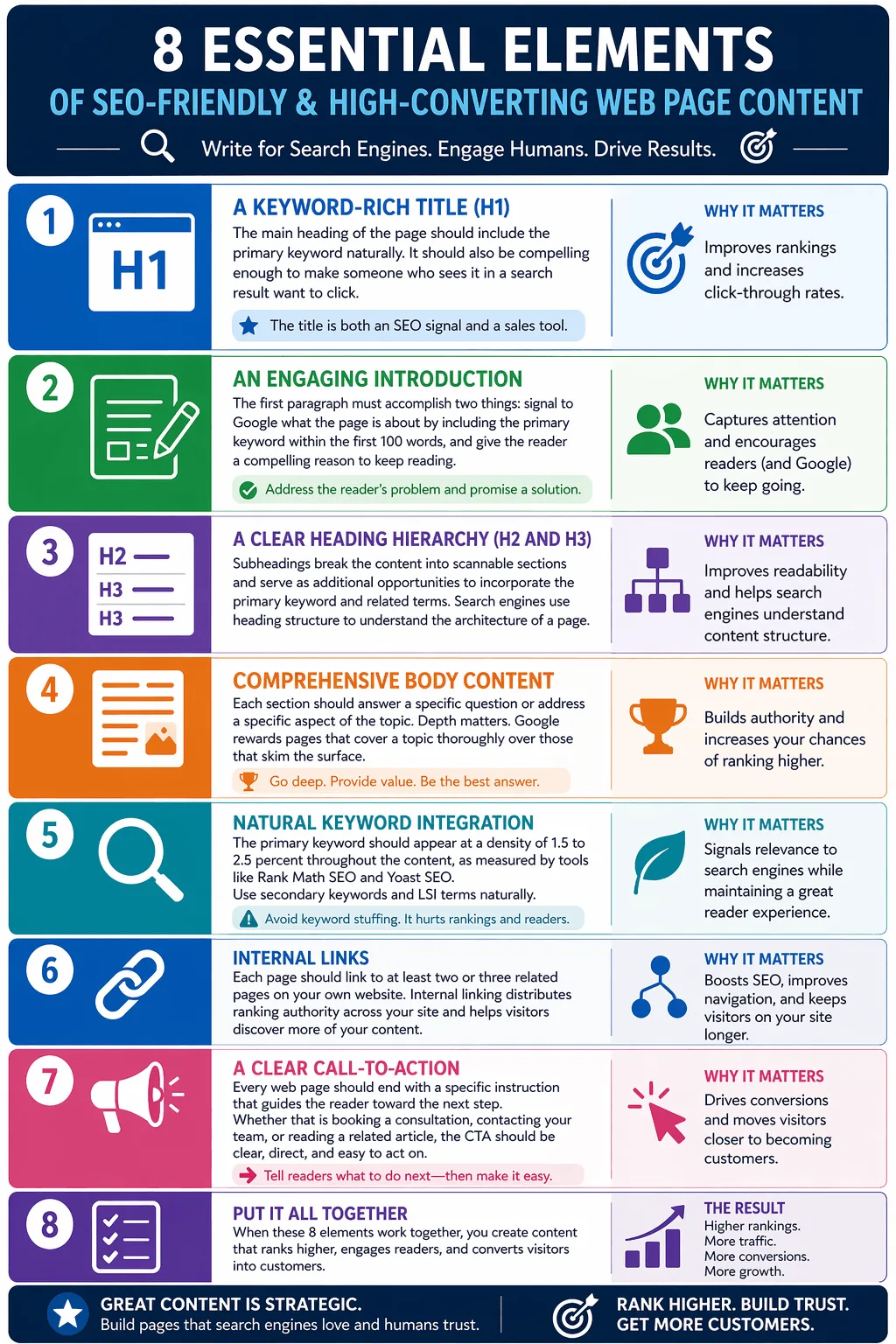
- A Keyword-Rich Title (H1) – The main heading of the page should include the primary keyword naturally. It should also be compelling enough to make someone who sees it in a search result want to click. The title is both an SEO signal and a sales tool.
- An Engaging Introduction – The first paragraph must accomplish two things: signal to Google what the page is about by including the primary keyword within the first 100 words, and give the reader a compelling reason to keep reading. A strong introduction addresses the reader’s problem directly and promises a solution.
- A Clear Heading Hierarchy (H2 and H3) – Subheadings break the content into scannable sections and serve as additional opportunities to incorporate the primary keyword and related terms. Search engines use heading structure to understand the architecture of a page.
- Comprehensive Body Content – Each section should answer a specific question or address a specific aspect of the topic. Depth matters. Google rewards pages that cover a topic thoroughly over those that skim the surface.
- Natural Keyword Integration – The primary keyword should appear at a density of 1.5 to 2.5 percent throughout the content, as measured by tools like Rank Math SEO and Yoast SEO. Secondary keywords and LSI terms should appear naturally throughout. Keyword stuffing — forcing keywords into sentences where they do not belong naturally — is both off-putting for readers and penalized by search engines.
- Internal Links – Each page should link to at least two or three related pages on your own website. Internal linking distributes ranking authority across your site and helps visitors discover more of your content.
- A Clear Call-to-Action – Every web page should end with a specific instruction that guides the reader toward the next step. Whether that is booking a consultation, contacting your team, or reading a related article, the CTA should be clear, direct, and easy to act on.
-
Applying this structure consistently across every page of your website creates a coherent, search-friendly experience for both Google’s crawlers and your human visitors. A web page content writer who works to this blueprint will produce pages that gain traction far more reliably than those written without structural guidance.
The Role of Readability in SEO Rankings
Readability is a ranking factor in practice, if not explicitly by name. Google measures signals like time-on-page, bounce rate, and scroll depth, all of which are directly influenced by how easy and enjoyable your content is to read. If a visitor lands on your page and immediately bounces because the text is dense, the paragraphs are too long, or the sentences are needlessly complex, Google interprets that as a quality signal. Pages with high bounce rates and low engagement tend to lose rankings over time.
A professional web page content writer applies readability principles throughout their work. Short paragraphs (two to four sentences maximum) make scanning easier. Active voice makes sentences feel direct and energetic. Plain language over jargon ensures that your content is accessible to the widest possible audience. Subheadings every 200 to 300 words give readers visual anchors that keep them moving through the page. All of these practices improve the reading experience and, in turn, improve the signals that Google uses to evaluate your content’s quality.
How to Use Rank Math SEO and Yoast SEO to Optimize Your Web Page Content
Two of the most widely used on-page SEO tools for WordPress websites are Rank Math SEO and Yoast SEO. Both plugins are designed to help website owners and web page content writers optimize individual pages and posts for specific keywords, and both provide real-time feedback on a range of SEO factors. Understanding how to use these tools effectively is one of the most practical skills any small business owner can develop.
Whether you are working with a web page content writer or producing content yourself, these plugins act as a co-pilot that guides you toward SEO best practices at the page level. Here is how to use them most effectively:
Setting Your Focus Keyword
Both Rank Math and Yoast require you to enter a focus keyword before they can analyze your content. This is the primary keyword you want the page to rank for. Once entered, both plugins analyze your content and score it against a range of SEO criteria. The goal is to achieve a green score in both tools, which indicates that your content meets the technical SEO requirements for that keyword. This score is a useful benchmark, but it is a starting point rather than a guarantee of rankings.
Keyword Density: Hitting the Right Target
Keyword density refers to the percentage of times your focus keyword appears in relation to the total word count of your content. Both Rank Math and Yoast recommend a density of between 1.5 and 2.5 percent. To calculate this manually, divide the number of times your keyword appears by the total word count of the page and multiply by one hundred. For a 1,500-word page, this means your keyword should appear between approximately 22 and 38 times. This range ensures that your keyword is prominent enough for search engines to identify the page’s topic without the content feeling forced or repetitive to human readers.
It is important to note that keyword density alone does not determine rankings. A page with the perfect keyword density but thin, low-quality content will not outrank a comprehensive, well-written page that uses the keyword slightly less frequently. Think of density as a hygiene factor — it needs to be right, but it works in combination with content quality, relevance, and depth.
Checking Your Meta Description and Title Tag
Both Rank Math and Yoast analyze your page title and meta description for keyword inclusion and optimal length. The meta description is the short paragraph that appears beneath your page title in Google search results — it does not directly affect rankings, but it significantly affects click-through rate, which in turn influences rankings over time. A well-written meta description includes the focus keyword, communicates the value of the page clearly, and contains a subtle call-to-action. Keeping it between 150 and 160 characters ensures it displays fully in search results without being truncated.
Internal and External Linking Requirements
Both SEO plugins flag pages that lack internal links. As noted earlier in this guide, internal linking is a critical component of a strong content strategy. Rank Math specifically recommends at least one internal link per page, while Yoast requires at least one as well. In practice, linking to three to five relevant pages within your own site per article is a strong target. Both tools also flag content that lacks any external links to authoritative sources. Citing credible external references — such as industry research, government statistics, or well-established organizations — strengthens your E-E-A-T signals and demonstrates to Google that your content is informed and well-researched.
Making these tools part of your standard content creation workflow ensures that every page your web page content writer produces meets the baseline on-page SEO requirements before it is published. Think of Rank Math and Yoast as your quality control checkpoint.
Web Page Content Writing vs. AI Content Systems: What Small Businesses Need to Know
The rise of artificial intelligence writing tools has transformed the content landscape over the past few years, and small business owners now face a genuinely new set of choices when deciding how to create website content. Understanding the difference between hiring a traditional web page content writer, using an AI content system, or working with a hybrid model that combines both approaches is essential for making smart decisions about your content budget and strategy.
Traditional Web Page Content Writers
A traditional freelance or agency web page content writer brings human creativity, industry experience, and nuanced writing skills to every project. For complex industries, brand storytelling, high-stakes sales pages, and deeply technical topics, experienced human writers remain the gold standard. The limitations of this model are cost and scalability — skilled writers charge accordingly for their expertise, and producing large volumes of content can become expensive quickly. Consistency can also vary when multiple writers work on a single website.
AI-Assisted Content Systems
Modern AI content systems — including the platform offered by Website Content Writers — address the scale and consistency challenges of traditional writing by using structured workflows and artificial intelligence to produce draft content rapidly. The key distinction between a well-designed AI content system and generic AI writing tools is that quality systems incorporate SEO strategy, keyword targeting, audience research, and content structure into the generation process. The output is not raw AI text — it is a structured, SEO-informed draft that is ready for human refinement.
For small business owners who need to produce regular blog content, update service pages, and maintain a consistent publishing schedule without the budget for a full-time writer, AI-assisted content systems offer a practical solution. The most important thing to understand is that the best results come from treating AI-generated drafts as a starting point, not a finished product. Human review, factual verification, and personalization remain essential steps.
The Hybrid Model: The Best of Both Worlds
The most effective approach for most small businesses in 2026 is a hybrid model: AI-generated, SEO-structured drafts refined and personalized by a human editor. This approach combines the speed and consistency of structured content systems with the nuance and authenticity that only human expertise provides. Website Content Writers is built around exactly this model — delivering AI-generated, keyword-optimized drafts with the option for expert human editing at every stage. For small businesses without a dedicated marketing team, this represents a cost-effective path to consistent, high-quality website content.
Website Content Writers offers a free AI SEO blog content creator for small business owners, with optional human editing available from a team of experienced content professionals. Visit websitecontentwriters.org to generate your first SEO blog post at no cost.
A Step-by-Step System for Creating Ranking Web Page Content
Everything discussed in this guide comes together in a repeatable, step-by-step system that any small business owner can follow. Whether you are briefing a web page content writer, working with an AI content platform, or writing the content yourself, this framework ensures that every page you publish is strategically positioned to rank and convert. Follow each step in sequence for the best results.
Step One: Define the Page Goal and Audience
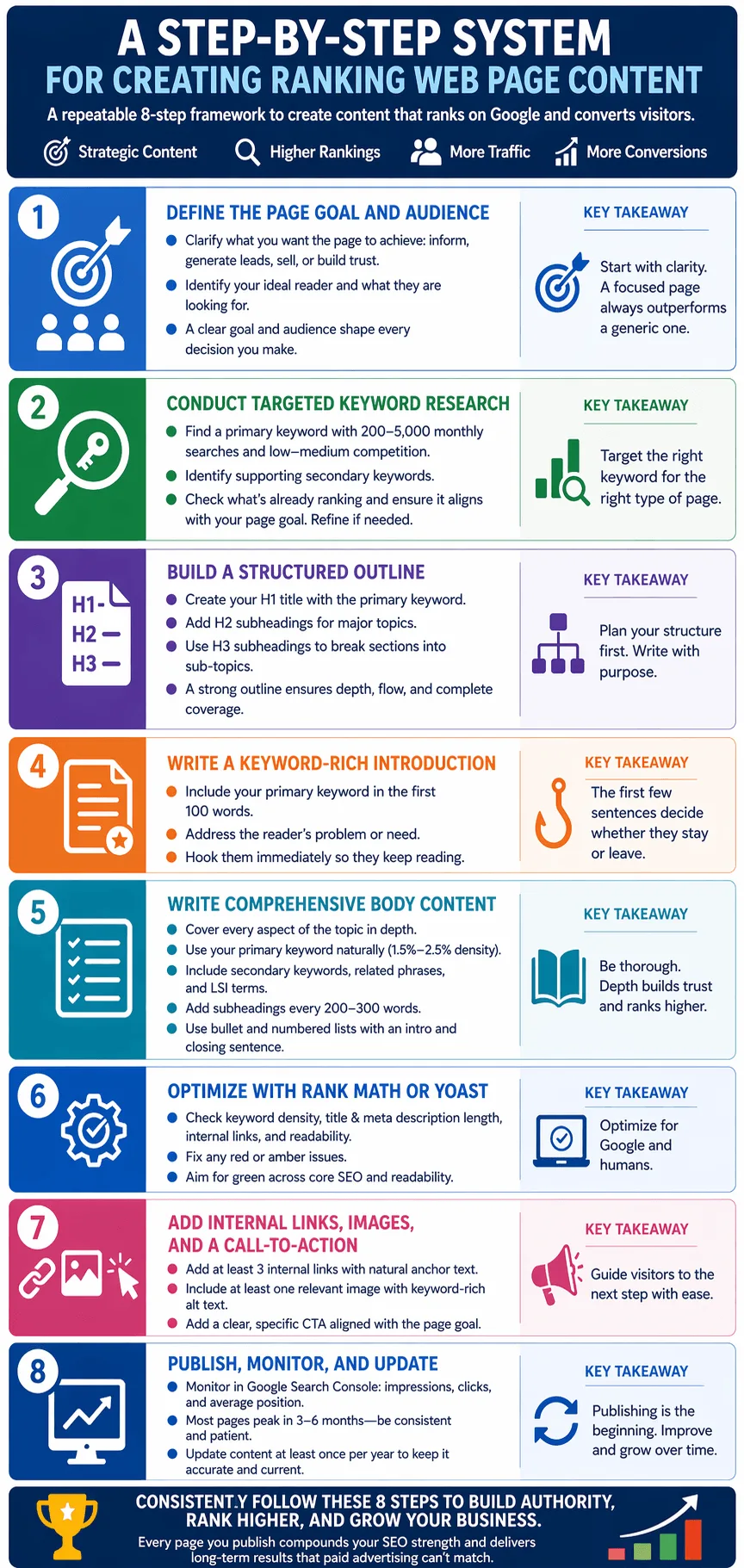
Before any research or writing begins, clarify exactly what you want this specific page to achieve and who you want it to reach. A page without a clear goal almost always underperforms, regardless of how well it is written. Ask yourself: Is this page designed to inform, generate leads, sell a product, or build trust? Who is the ideal reader — and what are they looking for when they land on this page? Answering these questions shapes every subsequent decision.
Step Two: Conduct Targeted Keyword Research
Using the tools and approaches outlined earlier in this guide, identify your primary focus keyword and a set of supporting secondary keywords. For most small business pages, the primary keyword should have between 200 and 5,000 monthly searches and low to medium competition. Confirm that the keyword aligns with your page goal by checking what kind of content currently ranks for it. If the top results are informational blog posts, but you want to create a sales page, you may need to refine your keyword choice.
Step Three: Build a Structured Outline
Create a heading hierarchy for the page before writing a single sentence of body content. Your outline should include the H1 page title (containing the primary keyword), a set of H2 subheadings (each covering a major aspect of the topic), and H3 subheadings where needed to break sections into focused sub-topics. A well-constructed outline eliminates writer’s block, ensures comprehensive topic coverage, and gives your web page content writer a clear structural blueprint to follow.
Step Four: Write a Keyword-Rich Introduction
The opening paragraph of every web page should include your primary keyword within the first 100 words. This is a widely recommended practice that signals to both Google and your reader what the page is about from the outset. Beyond keyword placement, the introduction must hook the reader by speaking directly to their problem or need. The first few sentences determine whether a visitor stays or bounces, so invest time in crafting an opening that is both relevant and compelling.
Step Five: Write Comprehensive Body Content
Work through each section of your outline systematically, providing depth and value in every paragraph. Aim to answer every question a reader might have about the topic without making them visit another website for clarification. Incorporate your primary keyword naturally throughout the content, maintaining a density of approximately 1.5 to 2.5 percent. Use secondary keywords, related phrases, and LSI terms throughout to signal topical depth. Break up text with subheadings every 200 to 300 words, and use bullet lists and numbered lists where they aid clarity — always preceded by an introductory sentence and followed by a concluding observation.
Step Six: Optimize with Rank Math or Yoast
Once the draft is complete, run it through your chosen SEO plugin. Check keyword density, title and meta description length, internal linking, and readability scores. Address any red or amber flags before moving to the final review stage. The goal is a green score across the core SEO requirements, combined with a readability score that confirms the content is clear and well-structured.
Step Seven: Add Internal Links, Images, and a Call-to-Action
Insert at least three internal links to related pages on your website, choosing anchor text that describes the destination page naturally. Add at least one relevant image with a descriptive alt tag that includes your focus keyword where appropriate. Finally, review your call-to-action and ensure it is visible, specific, and aligned with the page goal. A page with great content but a weak or absent CTA misses the conversion opportunity that good rankings create.
Step Eight: Publish, Monitor, and Update
Publishing the page is not the end of the process — it is the beginning. Monitor performance in Google Search Console, tracking impressions, clicks, and average position for your target keyword. Most well-optimized pages take between three and six months to reach their peak ranking position, so consistency and patience are important. Update your content at least once per year to ensure that statistics, references, and information remain current. Google rewards regularly refreshed content with sustained or improved rankings.
Following this eight-step system consistently will produce a website that grows in authority and organic visibility over time. Each page you publish adds to the cumulative SEO strength of your domain, compounding your results in a way that paid advertising never can.
Common Web Page Content Writing Mistakes That Kill Your Rankings
Understanding what to do is essential. Understanding what not to do is equally important. Many small business websites work hard on content creation only to undermine their own results with avoidable mistakes. A professional web page content writer is trained to recognize and avoid these pitfalls, but if you are managing your own content, being aware of them gives you a significant advantage.
The following mistakes are among the most common reasons why website content fails to rank, even when the topic is relevant and the writing is competent.
-
- Keyword Stuffing – Forcing your focus keyword into every other sentence in an unnatural way is a practice penalized by Google and immediately noticeable to readers. Natural keyword usage at an appropriate density is always more effective than repetitive, forced placement.
- Thin Content – Pages with fewer than 300 words almost never rank for competitive keywords. Google interprets thin content as low-value and deprioritizes it in search results. Even shorter pages like product descriptions benefit from additional context, supporting information, and frequently asked questions.
- Duplicate Content – Copying content from another page on your own site or from an external source is penalised heavily. Every page on your website should feature original content that adds unique value.
- Ignoring Search Intent – Writing a sales page for a keyword that searchers use when looking for information, or writing an informational post for a keyword with purchase intent, creates a mismatch that Google identifies and ranks accordingly. Always align content format with the intent behind the keyword.
- No Internal Links – Treating each page as an isolated island rather than connecting it to the rest of your website is a missed SEO opportunity. Internal linking is one of the easiest and highest-impact improvements any small business owner can make.
- Missing or Weak Meta Descriptions – Leaving the meta description blank or allowing it to auto-generate from the first paragraph often produces a poor result that fails to attract clicks. A well-written meta description can increase click-through rate by a meaningful margin without any change to your actual ranking position.
- Publishing Without Editing – Grammatical errors, unclear sentences, and factual mistakes damage trust and engagement. Every piece of web page content should be proofread before publication, whether by the writer, a colleague, or an editing service.
Avoiding these seven mistakes consistently will put your content ahead of a significant proportion of the competition. Many small business websites make several of these errors simultaneously, which means addressing them creates an immediate and measurable improvement in organic performance.
When to Hire a Web Page Content Writer vs. When to Use a Content Service
One of the most practical decisions any small business owner faces is whether to hire a dedicated web page content writer or to use a managed content service like Website Content Writers. Both approaches have genuine advantages, and the best choice depends on your specific business situation, budget, content volume, and long-term goals.
Hire a Freelance Web Page Content Writer When…
There are specific circumstances where a dedicated freelance web page content writer is likely to be the strongest choice. These situations involve a need for deep, industry-specific expertise, complex content that requires significant research, or high-stakes writing projects where the quality and nuance of every word directly impacts revenue. The following scenarios point toward working with an individual writer:
-
-
- Your industry requires deep specialist knowledge that only an experienced writer in your field would have — such as law, medicine, engineering, or financial services.
- You need high-conversion sales pages or brand positioning work where tone, voice, and persuasion are as important as keyword optimization.
- You want to build a long-term relationship with a writer who will develop genuine familiarity with your brand, your customers, and your competitive landscape over time.
- You have a relatively modest content volume — perhaps four to eight pieces per month — that justifies the investment in a skilled individual writer.
-
In these situations, the investment in a skilled freelance writer typically pays for itself through the quality and performance of the content produced.
Use a Content Service When…
A managed content service is the stronger choice when your primary goals are volume, consistency, speed, and cost-efficiency. For small businesses that need to maintain an active blog, regularly update service pages, and publish content across multiple topics, a content service provides infrastructure that is difficult to replicate with a single freelance writer. Website Content Writers is designed precisely for this scenario — providing keyword-optimized, SEO-structured content at a scale and price point that works for small business budgets.
-
-
- You need to publish consistently — multiple times per week — to build your site’s domain authority and maintain a competitive presence in your niche.
- Budget constraints make hiring a specialist writer for every piece of content unsustainable, but you still need high-quality, SEO-optimized output.
- You want the flexibility to add human editing on select pieces while using AI-assisted drafts for standard content.
- You have limited time to manage content creation and need a system that requires minimal input to produce publish-ready material.
-
The choice between a freelance web page content writer and a content service is not permanent. Many small business owners start with a service to build their content library quickly and then bring in specialist writers for specific high-priority projects as their marketing budget grows.
Frequently Asked Questions About Web Page Content Writing
The following frequently asked questions address the most common concerns and points of confusion that small business owners encounter when beginning to work with a web page content writer or develop their own content strategy. Each answer is designed to give you practical, actionable guidance that you can apply immediately.
FAQ 1: How long should web page content be for good SEO performance?
The ideal length for web page content depends on the type of page and the competitive landscape for your target keyword. As a general guideline, homepage content typically performs well at between 500 and 1,000 words, while service pages benefit from 600 to 1,500 words of focused, benefit-driven content. Blog posts and long-form articles aimed at competitive informational keywords perform best at between 2,000 and 5,000 words, since this length allows for the comprehensive topic coverage that Google rewards with strong rankings.
The most reliable way to determine the right length for a specific page is to examine the content length of the pages currently ranking in the top five positions for your target keyword. If the top results average 3,000 words, producing a page of 800 words is unlikely to compete successfully. Matching or exceeding the depth of existing top-ranking content, while adding original value and insight, gives your page the best chance of climbing the rankings.
It is important to emphasize that length is not a ranking factor in isolation. A 5,000-word page filled with repetitive, low-value content will consistently be outranked by a focused, well-written 2,500-word page that genuinely serves the reader. Depth and quality together determine performance — not word count alone.
FAQ 2: How many times should my keyword appear in a web page for Rank Math and Yoast to give me a green score?
Both Rank Math SEO and Yoast SEO recommend a keyword density of between 1.5 and 2.5 percent to achieve a green score for keyword usage. To calculate this, divide the number of times your keyword appears by the total word count of the page and multiply by one hundred. For a page of 1,500 words, your focus keyword should appear approximately 22 to 37 times. For a 2,500-word article, the keyword should appear between roughly 37 and 62 times. Both tools display a real-time density reading in their analysis panel, which makes it straightforward to monitor as you write.
Beyond raw density, both plugins check that your focus keyword appears in several specific locations: the SEO title tag, the meta description, the first paragraph of the content (within the first 100 words), at least one H2 subheading, and the URL slug of the page. Missing any of these placements will reduce your overall SEO score even if your general keyword density is within the target range. A professional web page content writer is familiar with all of these requirements and works them into the content naturally rather than as an afterthought.
One important caution: chasing a green score at the expense of readability is counterproductive. If hitting the target density requires forcing your keyword into sentences where it does not read naturally, you are better served by a slightly lower density and a higher-quality reading experience. Google’s algorithms are sophisticated enough to identify keyword stuffing, and readers will notice it too. Aim for the target range, but let natural writing take priority.
FAQ 3: Can I use AI tools to write my web page content, and will Google penalize it?
This is one of the most frequently asked questions in the content marketing space right now, and the answer requires some nuance. Google’s official position, confirmed in its documentation and statements from its Search Relations team, is that it does not penalize content simply because it was generated or assisted by AI. What Google penalizes is content that is unhelpful, low-quality, misleading, or that appears to have been produced at scale without genuine editorial oversight. The origin of the content — human or AI — is not the determining factor. The quality and helpfulness of the content is.
This means that AI-assisted content, when produced through a structured, SEO-informed workflow and reviewed by a human editor, can rank just as effectively as content written entirely by hand. The Website Content Writers platform operates on exactly this principle — using AI to generate structured, keyword-optimized drafts and offering human editing as the quality assurance layer. The result is content that meets Google’s quality standards while being produced far more efficiently than purely manual methods allow.
The risk with AI content arises when it is used without any editorial process — generating large volumes of thin, unreviewed, factually unreliable content purely for the purpose of occupying search engine space. Google’s Helpful Content system is specifically designed to identify and down-rank this kind of content. For small business owners using AI tools responsibly — as a first-draft tool reviewed and refined by a human — there is no penalty to worry about, and significant efficiency gains to enjoy.
FAQ 4: How long does it take to rank after publishing new web page content?
SEO timelines are one of the most common points of confusion for small business owners who are new to content marketing. The honest answer is that ranking results vary significantly depending on the competitiveness of your target keyword, the current domain authority of your website, the quality of your content, and the technical health of your overall site. As a general benchmark, most well-optimised pages on relatively new websites begin appearing in Google search results within four to twelve weeks of publication. However, reaching the first page for competitive keywords often takes between three and twelve months of consistent publishing and SEO effort.
Long-tail keywords with low competition can rank significantly faster — sometimes within days or weeks if your website has existing domain authority and your content is well-optimized. This is one of the strongest arguments for beginning your content strategy with highly specific, lower-competition keywords and building toward more competitive terms as your domain authority grows.
The most important thing to understand about SEO timelines is that content marketing operates on a compounding model. The first few months may feel slow. But as you publish consistently, each new page adds to your site’s authority, the number of keywords you rank for grows, and the traffic you receive accelerates. Business owners who commit to a consistent content strategy for twelve months almost always see results that justify the investment many times over. Patience and consistency are the two most important factors in any web page content writing strategy.
Conclusion: Your Next Steps as a Small Business Content Creator
Creating website content that ranks on Google is not a mystery reserved for marketing agencies and SEO specialists. It is a learnable, repeatable process that any small business owner can implement with the right guidance, the right tools, and a commitment to consistency. The core principles are clear: understand what your audience is searching for, write comprehensive and genuinely helpful content, optimize it correctly using tools like Rank Math SEO and Yoast SEO, publish it consistently, and monitor its performance over time.
A skilled web page content writer— whether that is a freelance professional, an AI-assisted content platform, or a combination of both — is one of the most valuable investments a small business can make in its long-term growth. Unlike paid advertising, which stops delivering results the moment you stop spending, well-optimized website content continues to attract organic traffic, generate leads, and build brand authority for months and years after it is published.
Website Content Writers exists to make this process accessible for exactly the kind of business owner this guide is written for: someone who understands the value of great content but does not have the time, technical knowledge, or budget to build a content program from scratch. Our free AI SEO blog content creator generates structured, keyword-optimized drafts in minutes, with expert human editing available whenever you want it. You keep control of your content strategy without spending your week writing blog posts.
Start today. Choose one keyword your target customers are searching for. Write a comprehensive, helpful page that genuinely answers their question. Optimize it using Rank Math or Yoast. Publish it. Then do the same thing next week. That simple habit, applied consistently, will transform your website from a digital brochure into a lead-generating asset that works for your business around the clock.
Ready to create your first SEO blog post? Visit websitecontentwriters.org and use our free AI blog content creator to generate a structured, keyword-optimized draft in minutes. Optional human editing is available for any post.