
If you run a small business and you have been told that consistent blogging is the key to getting found on Google, you have probably already experienced the frustration of starting strong and then watching your schedule fall apart within a few weeks. The truth is that most small business owners do not struggle with content because they lack ideas — they struggle because they have no system. A well-built blog content calendar for small business is that system, and it is the difference between publishing sporadically and building a content engine that works for your business around the clock.
This guide is written for small business owners who wear multiple hats, do not have a dedicated marketing team, and need a practical, repeatable approach to content planning that fits into real life. You will not find vague theory here. Every step in this guide is something you can implement this week, starting with a blank spreadsheet and a clear head.
By the time you finish reading, you will understand exactly how to build, fill, and maintain a blog content calendar for small business that supports your SEO goals, keeps your publishing consistent, and makes content creation feel manageable rather than overwhelming.
Why Every Small Business Needs a Blog Content Calendar
Most small business owners approach blogging in one of two ways. Either they publish a burst of posts when motivation is high, then go quiet for weeks, or they plan to blog consistently and keep pushing it to the bottom of the to-do list. Both approaches share the same outcome: a website that Google cannot take seriously, and an audience that never builds.
A structured blog content calendar for small business changes that pattern at the root. Rather than relying on motivation or memory, you create a forward-looking plan that tells you exactly what to write, when to publish it, and how each piece of content connects to your broader business goals. The result is consistency — and in SEO, consistency is one of the most powerful signals you can send to Google.
The Real Cost of Publishing Without a Plan
When small business owners publish without a plan, a series of predictable problems emerge. Topics overlap, leaving you with multiple posts competing for the same keyword. Important audience questions go unanswered because nobody identified them in advance. Posts are published randomly, with no internal linking strategy connecting them to each other or to your core service pages. And because there is no accountability built into the process, weeks pass without a single new piece of content going live.
Google rewards websites that publish consistently and cover topics with depth. A site that publishes three strong posts per week for two months will consistently outrank a site that publishes thirty posts in one month and then goes silent. That is because Google uses crawl frequency as one of many signals to assess the health and relevance of a website. Regular publishing tells Google that your site is active, maintained, and worth returning to.
What a Blog Content Calendar Does for Your SEO Rankings
A blog content calendar for small business does far more than keep you organized. It allows you to think strategically about your content before you create it, which means every post serves a specific purpose. Rather than writing about whatever comes to mind, you are building a network of interconnected content that signals topical authority to Google — the idea that your website is a genuinely comprehensive resource on a particular subject.
Search engines in 2026 are sophisticated enough to evaluate not just individual pages, but the depth and coherence of a site’s entire content ecosystem. A well-planned content calendar ensures that your posts support each other through internal links, cover your niche from multiple angles, and avoid the cannibalizations that happens when two posts target the same keyword phrase. That level of strategic coherence is almost impossible to achieve without planning ahead. It is the kind of structure that turns a blog from a traffic-generating afterthought into one of your most reliable business assets.
What to Include in a Blog Content Calendar for Small Business
Before you start filling your calendar with topics, it is important to understand what a proper blog content calendar actually contains. Many small business owners make the mistake of treating their calendar as nothing more than a list of blog titles and publish dates. That is better than nothing, but it leaves out most of the information that makes a content calendar genuinely useful.
A strong blog content calendar for small business functions as a planning document and a production tracker at the same time. Every row in your calendar represents one piece of content, and every column captures a specific piece of information that affects how that content is created, optimized, and published.
The Six Essential Fields Every Calendar Entry Needs
Think of your content calendar as a blueprint. The more detail you include upfront, the less guesswork you face when it is time to write.
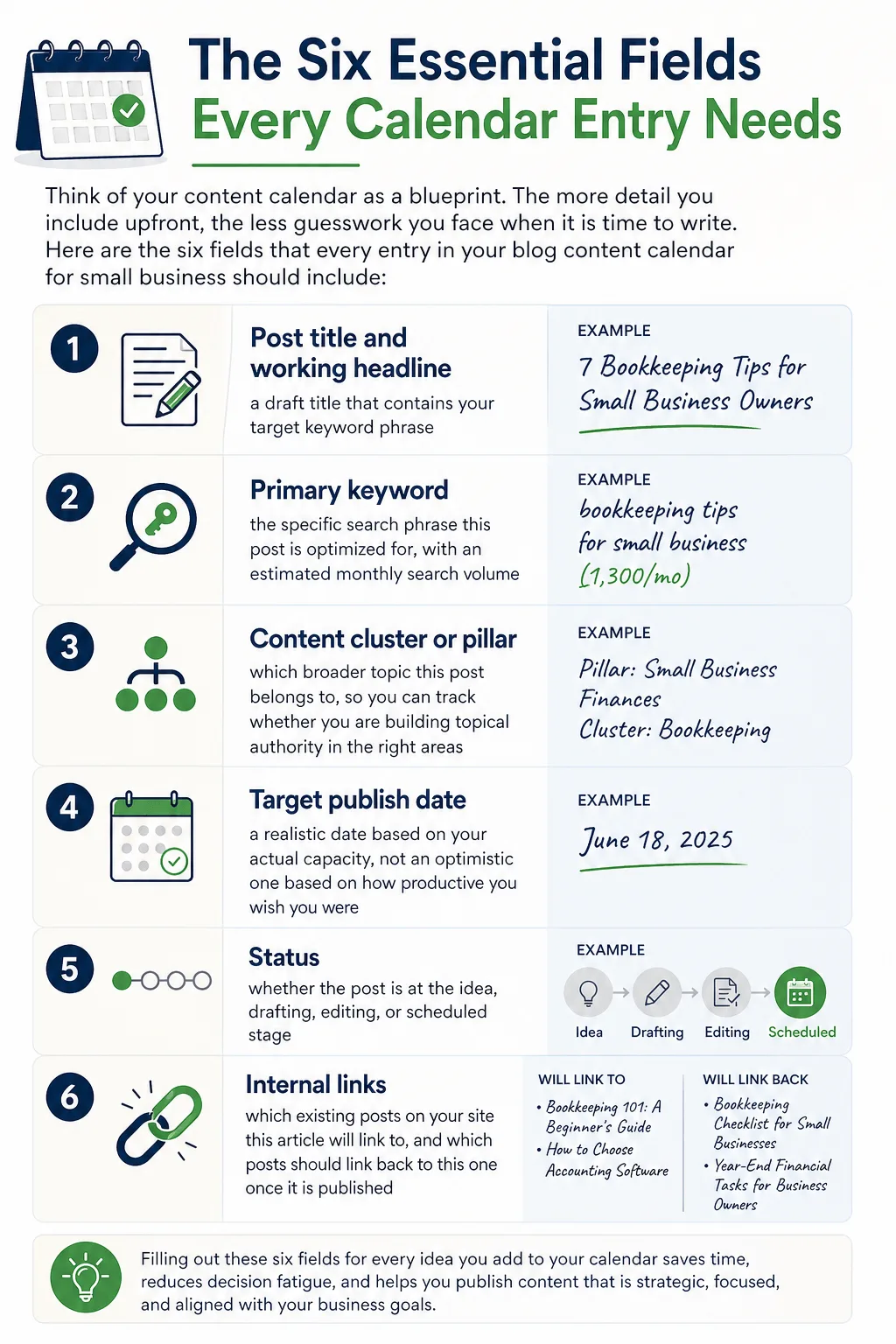
Here are the six fields that every entry in your blog content calendar for small business should include:
-
- Post title and working headline — a draft title that contains your target keyword phrase
- Primary keyword — the specific search phrase this post is optimized for, with an estimated monthly search volume
- Content cluster or pillar — which broader topic this post belongs to, so you can track whether you are building topical authority in the right areas
- Target publish date — a realistic date based on your actual capacity, not an optimistic one based on how productive you wish you were
- Status — whether the post is at the idea, drafting, editing, or scheduled stage
- Internal links — which existing posts on your site this article will link to, and which posts should link back to this one once it is published
These six fields are the minimum viable version of a content calendar that actually supports your SEO strategy. Some business owners add columns for word count targets, assigned writers, promotional channels, and performance data collected after publication. You can start simple and expand your calendar as your content operation grows.
Choosing Between a Spreadsheet, a Project Tool, or a Dedicated Platform
One of the most common questions from small business owners building their first blog content calendar is what tool to use. The answer depends entirely on your team size, technical comfort, and how complex your content operation is. Google Sheets or Microsoft Excel work exceptionally well for solo founders and small teams because they are free, flexible, and familiar. A simple spreadsheet with the six columns listed above is all most small businesses need to start publishing consistently.
If you work with a virtual assistant, a part-time editor, or a small content team, a project management tool like Trello, Notion, or Asana can add useful features like task assignments, status views, and comment threads. These tools allow multiple people to work from the same calendar without confusion. Dedicated content marketing platforms exist for larger teams, but they are unnecessary and often expensive for the businesses this guide is written for.
The most important principle here is that the tool serves the system, not the other way around. A beautifully designed Notion dashboard that you do not update weekly is far less useful than a basic Google Sheet that you actually maintain. Choose the simplest tool that you will consistently use.
How to Build a Blog Content Calendar for Small Business: A Step-by-Step System That Actually Works
Understanding what a blog content calendar is and knowing how to build one are two very different things. Many small business owners get as far as opening a blank spreadsheet, staring at it for ten minutes, and then closing it again because they are not sure where to start. The steps below remove that uncertainty entirely.
This is not a theoretical framework. It is a practical, sequential process that takes you from having no content plan at all to having a fully populated, keyword-driven blog content calendar for small business that you can start executing immediately. Each step builds on the one before it, so it is worth working through them in order rather than jumping ahead to the parts that feel most familiar.
One thing to keep in mind before you begin: do not try to complete all of these steps in a single sitting. Building a content calendar properly takes focused thinking, and rushing through the early stages — especially the goal-setting and keyword research steps — will undermine everything that comes after. Set aside two to three hours across a couple of sessions, and you will have a calendar that serves your business for months rather than a plan you abandon before the first post goes live.
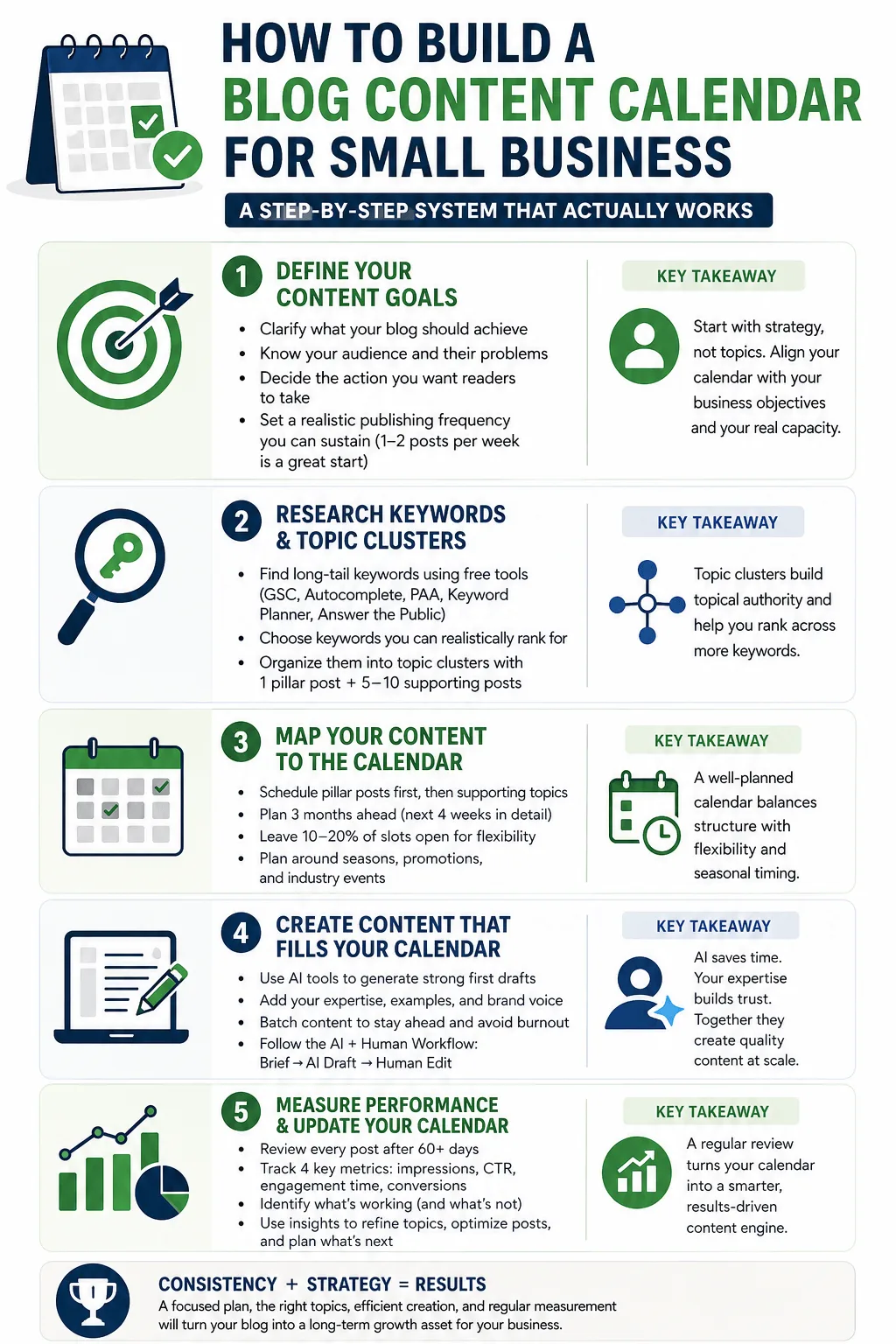
And so, without further ado, here are the five steps you need build a blog content calendar for small business websites:
Step One: Define Your Content Goals Before You Build Anything
The single most common mistake small business owners make when starting a blog content calendar is jumping straight to topic ideas. It feels productive to brainstorm post titles, but without a clear understanding of what your content is supposed to achieve, you end up with a calendar full of posts that generate traffic without converting anyone into a customer.
Before you plan a single post, spend thirty minutes answering three questions that will shape every decision you make about your blog content calendar for small business. First, what do you want your blog to accomplish — brand awareness, organic search traffic, direct lead generation, or positioning you as an expert in your field? Second, who is the specific person you are writing for, and what problems do they have that your business solves? Third, what action do you want each reader to take after they finish reading a post?
Aligning Your Blog Calendar With Your Business Objectives
Your content goals should map directly to your business objectives. If your priority this quarter is attracting more first-time customers, your calendar should prioritize posts that target informational keywords — search terms people use when they are in the research phase of the buying cycle, before they have decided who to hire or what to buy. If your priority is converting existing website visitors who already know your brand, your calendar should include posts that compare options, answer specific objections, and make a clear case for your service.
This alignment between business goals and content topics is what separates a professional blog content calendar for small business from a random list of article ideas. When every post connects to a specific objective, you can measure whether your blogging effort is actually producing results. You are not just publishing for the sake of publishing — you are executing a strategy with a measurable outcome.
Setting a Publishing Frequency You Can Actually Sustain
Once you know what your content is trying to achieve, you need to set a publishing frequency that is genuinely sustainable for your situation. This is where many small business owners set themselves up to fail by being overly optimistic. If you have never published more than one post a month, committing to four posts per week will not create momentum — it will create burnout followed by inactivity.
A realistic and sustainable cadence for most small businesses with limited resources is one to two posts per week. That frequency is enough to demonstrate consistency to Google, build topical authority over time, and maintain an audience without consuming your entire working week. If one post per week is all you can commit to reliably, that is a far better starting point than an ambitious schedule you cannot maintain past the third week.
Build your publishing targets into your blog content calendar from the beginning. If you publish on Tuesdays and Fridays, mark those dates across the next three months in your calendar before you assign a single post. This prevents overcommitting and makes it immediately visible when the calendar is getting too full to manage realistically.
Step Two: Research Your Keywords and Topic Clusters
With your goals defined and your publishing frequency established, the next step is filling your calendar with content that has a real chance of ranking on Google. For a small business with a relatively new website, this means focusing almost entirely on long-tail keywords — specific, multi-word search phrases that target a precise audience question or need.
Long-tail keywords work for smaller sites because they have significantly lower competition than broad terms. A keyword like “content marketing” has millions of competing pages and is dominated by industry giants with years of authority behind them. A keyword like “how to create a blog content calendar for small business” is specific enough that smaller, newer sites can appear on the first page of results — especially if the article is comprehensive and well-structured.
How to Find Long-Tail Keywords That Small Businesses Can Actually Rank For
Finding the right keywords for your blog content calendar does not require expensive software. Several free tools will give you enough data to make informed decisions. Here are the most practical options for small business owners working without a dedicated SEO budget:
-
-
-
- Google Search Console — if your site has been live for more than a few weeks, Search Console will show you which queries are already generating impressions. These are keywords Google already associates with your site, and writing more content around them is one of the fastest ways to improve rankings.
- Google Autocomplete — type a broad topic related to your business into the Google search bar and note the suggestions that appear. Each suggestion represents a real search that people are actively performing.
- People Also Ask — every Google results page for an informational query includes a “People Also Ask” section with related questions. These questions are outstanding long-tail keyword opportunities, especially for how-to and guide-style content.
- Google Keyword Planner — available free with a Google account, this tool shows estimated monthly search volume for any keyword phrase. Look for terms with between two hundred and five thousand monthly searches and low-to-medium competition.
- Answer the Public — a free tool that visualizes the questions people ask around any topic, organized by search intent. Excellent for generating cluster content ideas quickly.
-
-
When evaluating keyword opportunities, the goal is not to find the highest volume terms — it is to find terms you can realistically rank for given your site’s current authority. A keyword generating three hundred monthly searches where your article appears on page one will deliver far more traffic than a keyword generating thirty thousand searches where your article sits on page seven and nobody ever finds it.
Organizing Your Keywords Into Topic Clusters That Build Authority
Once you have a list of potential keywords, the next step is organizing them into topic clusters before adding them to your blog content calendar. A topic cluster is a group of related posts that all cover different aspects of the same subject, linked together through internal links and united by a pillar page that provides a comprehensive overview of the topic.
Topic clusters are important because they are how Google decides whether your site is a genuine authority on a subject. A site with one post about blog content planning will not rank as consistently as a site with twelve interconnected posts covering every aspect of content calendars, content strategy, keyword research for small businesses, how to measure blog performance, and how to use AI tools to speed up content creation. Google evaluates the entire content ecosystem, not just individual articles.
Building your blog content calendar around clusters rather than isolated posts is one of the most powerful strategic decisions a small business can make. For each cluster, identify one pillar topic and five to ten supporting topics. Your pillar post is the most comprehensive article — typically two thousand words or more — while your supporting posts dive deeper into specific sub-topics and link back to the pillar. Over time, this interconnected structure tells Google that your site has genuine depth on the subject, which results in better rankings across all the posts in the cluster.
Step Three: Map Your Content to the Calendar
With your keyword list and cluster structure in place, it is time to start populating your blog content calendar for small business with actual entries. This is the stage where planning becomes concrete, and where the real strategic thinking happens.
Start by placing your pillar posts first. Each cluster you identified in the previous step should have its pillar article scheduled early, because the supporting posts will all link back to it. Publishing a supporting post before the pillar it references exists creates a weak internal linking structure and undermines the authority-building effect you are trying to achieve.
How Far Ahead Should You Plan?
A rolling three-month plan is the ideal planning horizon for most small businesses. Planning three months ahead gives you enough time to spot seasonal opportunities, coordinate content with product launches or promotions, and batch your writing efficiently. It is also short enough that your plan remains flexible — you can adjust topics in response to industry news, shifts in your business priorities, or insights from your analytics without dismantling a rigid annual framework.
Within your three-month plan, aim to have the next four weeks fully detailed — with working titles, primary keywords, cluster assignments, and draft internal link plans in place. Weeks five through twelve can be outlined at a higher level, with topics and keywords assigned but not yet fully detailed. This two-tier approach balances strategic foresight with the flexibility to adapt as circumstances change.
Importantly, leave ten to twenty percent of your calendar slots open and unplanned. These buffer slots are where you will publish content responding to trends, news in your industry, or insights from your performance data. Some of the most effective blog posts come from noticing a question that customers ask repeatedly and addressing it immediately while it is on their mind.
Planning Around Seasons, Promotions, and Industry Events
A blog content calendar for small business that ignores the calendar year misses some of the most valuable traffic opportunities available to small businesses. Seasonal peaks, industry events, and shopping periods all create predictable spikes in specific search queries, and content that is published six to eight weeks before a seasonal peak is far more likely to rank than content published the week before it.
Think about the events that are most relevant to your specific customers. A tax preparation service needs blog content addressing year-end financial questions in October and November, well before the January rush. A local catering business should be publishing content about event planning, wedding season catering, and corporate lunch options two months before the busy seasons that drive its revenue. A content writing service should address topics like “content strategy for the new year” or “how to plan your blog for Q1” in the final weeks of the preceding quarter.
Mark these seasonal milestones in your calendar first, before filling in the evergreen content that forms the backbone of your editorial plan. Then work backwards from each seasonal peak to determine when the associated content needs to be published to have the best chance of ranking in time.
Step Four: Creating the Content That Fills Your Calendar
A blog content calendar is only as valuable as the content that actually gets produced to fill it. This is the step where most small business owners hit their biggest obstacle. Writing a detailed, keyword-optimized blog post takes time — often two to four hours for a single well-researched article — and that is time that most small business owners simply do not have in abundance.
This is where AI writing tools, used correctly, change the economics of content production for small businesses. Rather than replacing the thinking and judgment that makes content valuable, AI tools handle the most time-consuming part of the process: generating a structured first draft based on a keyword brief. A post that would take four hours to write from scratch can have a strong first draft ready in twenty minutes, leaving you to spend an hour on editing, adding specific examples from your own business experience, and refining the tone.
How to Use AI Tools to Stick to Your Blog Content Calendar Without Burning Out
The businesses that consistently maintain their blog content calendars are not the ones with the most time or the most writing talent — they are the ones with the most efficient content workflow. An efficient workflow for small business content production typically looks like this: you identify the keyword and outline the key points you want to cover, you use an AI writing tool to generate a structured draft, and you spend a focused editing session refining the draft into something that genuinely represents your brand voice and expertise.
What separates this approach from simply publishing unedited AI output is the human layer. Google’s quality systems are increasingly sophisticated at identifying content that is generic, unsupported by real expertise, or written without genuine knowledge of the subject. Your editing pass is where you add the specific examples, real client stories, and direct practical advice that make an article genuinely useful to a reader — and genuinely credible to Google.
Several practical strategies will help you maintain your publishing schedule without spending every free hour writing. Batching is the most powerful: rather than writing one post at a time throughout the week, set aside a single focused session — perhaps a morning every two weeks — to draft or review three to four posts in one sitting. This approach reduces the cognitive load of context-switching and lets you produce more content in less total time. Many small business owners find that batching their content creation allows them to stay three to four weeks ahead of their publishing schedule, which eliminates the weekly scramble that causes most content calendars to collapse.
The AI Plus Human Editing Workflow That Fits a Small Business Schedule
Understanding the right way to use AI in your content workflow is essential for maintaining your blog content calendar for small business without sacrificing quality. The most effective approach for small business owners is a clear three-stage process that keeps the human judgment front and center while letting AI handle the heavy lifting of first-draft generation.
The process works as follows:
-
-
-
- In Stage One, you create a keyword brief that includes your target keyword, the main questions the post needs to answer, the audience it is written for, and two or three internal links from existing posts on your site that are relevant to the topic.
- In Stage Two, you submit that brief to an AI writing tool and receive a structured draft that covers the topic comprehensively.
- In Stage Three — the most important stage — you edit the draft to add your specific expertise, remove any generic or unsupported claims, verify all statistics and facts, and adjust the tone to match your brand voice.
-
-
This three-stage process, when applied consistently, allows a single small business owner to produce two to three high-quality posts per week without the creative exhaustion that comes from generating everything from scratch. Services like Website Content Writers are designed specifically for this workflow, combining AI-driven first drafts with optional professional human editing so small business owners can publish consistently without clearing their diaries or hiring a full-time content writer.
Step Five: Measuring Performance and Updating Your Calendar
Publishing content is the beginning of the process, not the end. A blog content calendar for small business that does not include a performance review cycle is a plan without a feedback loop — and a plan without a feedback loop cannot improve.
Most blog posts take between three and six months to reach their peak ranking position on Google. This is normal, and it is why patience is essential in any content strategy. What matters during those first months is not obsessing over daily traffic numbers, but establishing the monitoring habit that will tell you which posts are gaining traction and which need to be refreshed or reconsidered.
The Four Metrics Every Small Business Should Track
Measuring the success of your blog content calendar does not require complex analytics knowledge. Four key metrics give you a clear enough picture to make intelligent decisions about your content strategy. Here they are, along with what they tell you and where to find them:
-
-
-
- Organic search impressions — the number of times your pages appeared in Google search results, found in Google Search Console under the Performance tab. Rising impressions signal that Google is starting to associate your content with relevant search queries, which typically precedes a rise in clicks.
- Click-through rate — the percentage of impressions that result in a click through to your site. A low click-through rate on a post with high impressions usually means your title or meta description needs improvement to better match what searchers are looking for.
- Average engagement time — found in Google Analytics, this metric tells you how long visitors spend actively reading your content. Posts with high engagement time are resonating with readers and are more likely to earn links and social shares over time.
- Conversion actions — any action a reader takes that connects to your business goals, whether that is signing up for a free trial, requesting a quote, clicking through to your pricing page, or contacting you directly. This is the metric that connects your blog content calendar to actual revenue.
-
-
Review these four metrics once a month for every post that has been live for more than sixty days. Look for patterns: which topics are generating the most impressions? Which posts are converting visitors into enquiries? Which articles have high time-on-page but low search traffic, suggesting they are valuable but not yet visible enough? These patterns should directly inform what you add to your content calendar in the coming months.
When to Update, Refresh, or Remove Blog Posts
One of the most underused strategies in small business blogging is content refreshing. Rather than always creating new posts, sometimes the highest-return activity is updating an existing post that is already ranking on page two or three of Google, has a recent date added to the title, and has new statistics, examples, and depth added to the body.
Google has signaled through multiple algorithm updates that freshness matters — not just for news content, but for any topic where the information evolves over time. A post about AI writing tools published in 2025 may need updating in 2026 to reflect new tools, changed pricing, and updated best practices. Updating that post with current information signals to Google that it is actively maintained, which can give it a meaningful rankings boost without the effort of creating a new post from scratch.
Build content refreshes into your blog content calendar for small business as a standing item. Allocating fifteen to twenty percent of your monthly content slots to updating existing posts, rather than always publishing new ones, is a mature content strategy that most small businesses overlook entirely. It is one of the quickest ways to generate more organic traffic from the content you have already invested time in creating.
Common Mistakes Small Business Owners Make With Their Blog Content Calendars
Building a blog content calendar for small business is a significant step forward from publishing without a plan. But there are several predictable mistakes that cause even well-intentioned calendars to stop working within a few months. Understanding these pitfalls in advance is the best way to avoid them.
The first and most common mistake is planning too far ahead with too much detail. Business circumstances change, industry trends shift, and what seemed like a great topic in January may feel irrelevant by March. Locking yourself into a rigid twelve-month plan with fully detailed briefs for every post leaves no room for the flexibility that effective content strategies require. Plan your next four weeks in detail, the next three months in outline, and review the broader plan monthly.
The second mistake is treating your blog content calendar as a list of titles rather than a strategic framework. A title without a keyword, a cluster assignment, or an internal link plan is just a reminder that something needs to be written. A full calendar entry is a mini-brief that tells you and anyone helping you exactly what the post is trying to achieve and how it fits into your broader content strategy.
The third common mistake is stopping the calendar when publishing falls behind. Missing one week is not a reason to abandon the calendar — it is a reason to reassess whether the publishing frequency you committed to is actually realistic. Scaling back from two posts per week to one post per week is a perfectly valid strategic decision. Abandoning the calendar entirely because you missed a week is not. The calendar is a living document, and adjusting it in response to reality is normal and healthy.
How to Stay Consistent With Your Blog Content Calendar Long-Term
Consistency is the quality that separates content strategies that generate traffic from those that generate occasional spikes followed by silence. The businesses that rank well in competitive niches are almost never the ones that published the most content in a single month — they are the ones that published steadily and strategically over the longest period of time.
Maintaining a blog content calendar for small business over the long term requires two practical habits that are easy to describe and genuinely challenging to sustain: batching and reviewing.
Batching Your Content Creation to Stay Ahead of Your Calendar
Batching means consolidating your content creation into dedicated, focused sessions rather than trying to squeeze a post in between other tasks throughout the day. The cognitive cost of switching from one type of work to another is significant, and it is one of the main reasons small business owners find blogging exhausting. When you sit down to write with a clear keyword brief in hand, a quiet hour, and no other tasks competing for your attention, the writing goes faster and the result is better.
A practical batching approach for a small business owner publishing two posts per week looks like this: one morning per week — perhaps every Tuesday — is reserved for content work. During that morning, you review and edit AI-generated drafts for two posts, complete any final internal linking, write or review meta descriptions, and schedule the posts for publication. Nothing else happens during that time. It is protected content time, and protecting it is what makes the difference between a content calendar that produces results and one that looks good in a spreadsheet but never gets executed.
Building a Monthly Review Into Your Calendar Routine
Every blog content calendar for small business needs a regular review session where you look backwards at performance and forwards at the plan. A monthly review does not need to be long — sixty minutes on the last Friday of each month is sufficient for most small businesses — but it should be consistent and structured.
During your monthly review, check the four performance metrics covered in the previous section, identify any posts that are gaining enough impressions to justify a refresh or expansion, confirm that the next four weeks of your calendar are fully detailed with briefs and keywords, add any new topic ideas that emerged from customer conversations or industry news during the past month, and remove any planned topics that no longer feel strategic or relevant.
This monthly review is what transforms a blog content calendar from a static planning document into a dynamic system that gets smarter over time. The best content strategies are not the ones that are planned perfectly at the beginning — they are the ones that incorporate what is actually working and respond intelligently to the data.
Putting It All Together: Your Blog Content Calendar for Small Business in Action
A blog content calendar for small business is not a complex or expensive thing to build. It is a simple, consistent system that answers the question of what to publish, when to publish it, and why — before you sit down to write a single word. The businesses that grow their organic traffic year over year are not doing anything magical. They are publishing the right content, on a consistent schedule, in a way that builds topical authority over time.
The steps in this guide give you everything you need to build that system from scratch. Define your goals, research your keywords, organize your topics into clusters, build your calendar around a sustainable publishing frequency, use AI tools to speed up content creation without sacrificing quality, and review your performance monthly to make smarter decisions with every passing week.
If the process of creating the content itself feels like the biggest barrier — and for most small business owners, it is — services like Website Content Writers exist to bridge exactly that gap. You bring the keyword and the brief. The platform handles the draft. Your editing session turns it into something genuinely useful, genuinely yours, and genuinely ready to rank.
The calendar is the strategy. The content is the execution. Get both working together, and the results compound.
Frequently Asked Questions About Creating a Blog Content Calendar for Small Business
Here are the most commonly asked questions around the topic of the creation of a blog content calendar for small business websites:
How many blog posts should a small business plan in their content calendar each month?
There is no universal answer, because the right number depends on your resources, your publishing quality, and your overall SEO goals. That said, most SEO research consistently supports quality over quantity, particularly for newer domains with limited authority. For a small business owner managing content alongside everything else their role demands, planning four to eight posts per month — roughly one to two per week — is a realistic and strategically sound target.
What matters far more than the total number of posts is the consistency with which you hit that target. A business that publishes four well-researched, properly optimized posts every month for twelve consecutive months will consistently outperform a business that publishes twenty posts in January and then goes quiet until April. Google evaluates patterns over time, and a reliable publishing cadence signals that your website is actively maintained and worth crawling regularly. Start with a number that feels slightly uncomfortable but achievable, sustain it for ninety days, and only then consider whether to increase the volume.
Do I need to use expensive tools to manage my blog content calendar for small business?
Absolutely not. Some of the most effective blog content calendars in use by small businesses today are built in free tools that you almost certainly already have access to. Google Sheets is the most common and arguably the most practical choice for solo founders and small teams. It is free, collaborative, accessible from any device, and flexible enough to include every field you need — from keyword assignments and cluster designations to internal link plans and performance notes.
If you want a slightly more visual experience, Notion offers a generous free tier that allows you to build database-style content calendars with status filters, tag systems, and gallery views. Trello is another free option that works well if you prefer a Kanban-style board where you can see each post moving through stages from idea to published. The principle to remember is that the value of your blog content calendar comes from the strategic thinking you put into it and the consistency with which you maintain it — not from the sophistication of the tool you use to track it.
How does a blog content calendar help a small business rank on Google?
A blog content calendar helps a small business rank on Google in three distinct ways that compound over time. The first is consistency: Google crawls websites more frequently when they publish on a regular schedule, which means new content gets indexed faster and signals that the site is actively maintained. The second is topical authority: when your calendar is organized around topic clusters rather than isolated posts, you are systematically building the interconnected content ecosystem that tells Google your site is a comprehensive resource on your subject. The third is keyword strategy: planning posts in advance forces you to research keywords before you write, which means every post has a clear ranking target instead of being written around vague, high-competition phrases that a newer site has no realistic chance of ranking for.
The compound effect is significant. A small business that maintains a strategic blog content calendar consistently for twelve months will typically see a meaningful and growing stream of organic search traffic by the end of that period. The traffic from each well-ranked post adds to the traffic from every other well-ranked post, building an audience that does not depend on paid advertising or social media algorithms to sustain itself.
How often should I update my blog content calendar for small business?
Your calendar should be reviewed and updated on two different rhythms. The first is a weekly check-in that takes no more than fifteen minutes: confirm that the posts scheduled for the coming week are ready to publish, make note of any new topic ideas that came up during the week, and flag any posts that are running behind schedule. This weekly check-in keeps the calendar current and prevents small delays from becoming large gaps in your publishing schedule.
The second rhythm is a monthly review, which takes approximately sixty minutes and is where the strategic decisions get made. During your monthly review, look at the performance data from posts published in the past four to six weeks, identify any pieces that are gaining search impressions and could benefit from a refresh or expansion, add any seasonal topics that need to be addressed in the coming quarter, and remove any planned posts that no longer align with your current business priorities. This monthly review is what keeps your blog content calendar relevant as your business evolves and as new information about your audience’s search behavior becomes available.
Need help filling your blog content calendar with professionally written, SEO-optimized posts? Website Content Writers combines AI speed with human editing quality to deliver publish-ready blog content for small businesses — starting with a free post, no credit card required. Visit websitecontentwriters.org to get started.