
Artificial intelligence has completely changed the way content is created online. If you run a small business with a website or blog, chances are you have already experimented with AI writing tools — or at least heard about them. But along with this wave of AI-generated content has come a very real concern: Is there a Google AI content detector watching everything you publish, and will it hurt your rankings?
This is one of the most searched questions among small business owners, bloggers, and entrepreneurs in 2026. And it is completely understandable. You have invested time and money into your website. You want it to rank on Google. The last thing you need is to discover that your AI-assisted blog posts are quietly being penalized by an algorithm you did not even know existed.
The truth about the Google AI content detector is more nuanced — and far less frightening — than most people believe. This comprehensive guide will break down exactly how Google evaluates AI-generated content, what actually determines whether your blog posts rank or get buried, and how you can use a powerful SEO strategy called topical authority to future-proof your content and outrank your competitors — even with limited time and no SEO background.
By the end of this article, you will understand why the conversation around the Google AI content detector is only one small piece of a much larger puzzle — and what the real levers are that drive small business rankings in 2026.
What Is a Google AI Content Detector — and Does One Actually Exist?
The phrase “Google AI content detector” is widely searched, but it is rooted in a fundamental misunderstanding of how Google works. When most people search for this term, they are trying to find out whether Google has a built-in system that automatically identifies and penalizes content written by AI. The short answer, backed by Google’s own official statements, is that Google does not operate a public-facing AI content detection system in the way most people imagine.
What does exist are dozens of third-party tools — platforms like Originality.ai and ZeroGPT — that claim to analyze text and determine whether it was written by a human or a machine. These tools have been widely adopted by academics, publishers, and even some marketing teams, but they are not tools used by Google. More importantly, they are riddled with reliability issues that make their results questionable at best.
How Third-Party Google AI Content Detectors Work
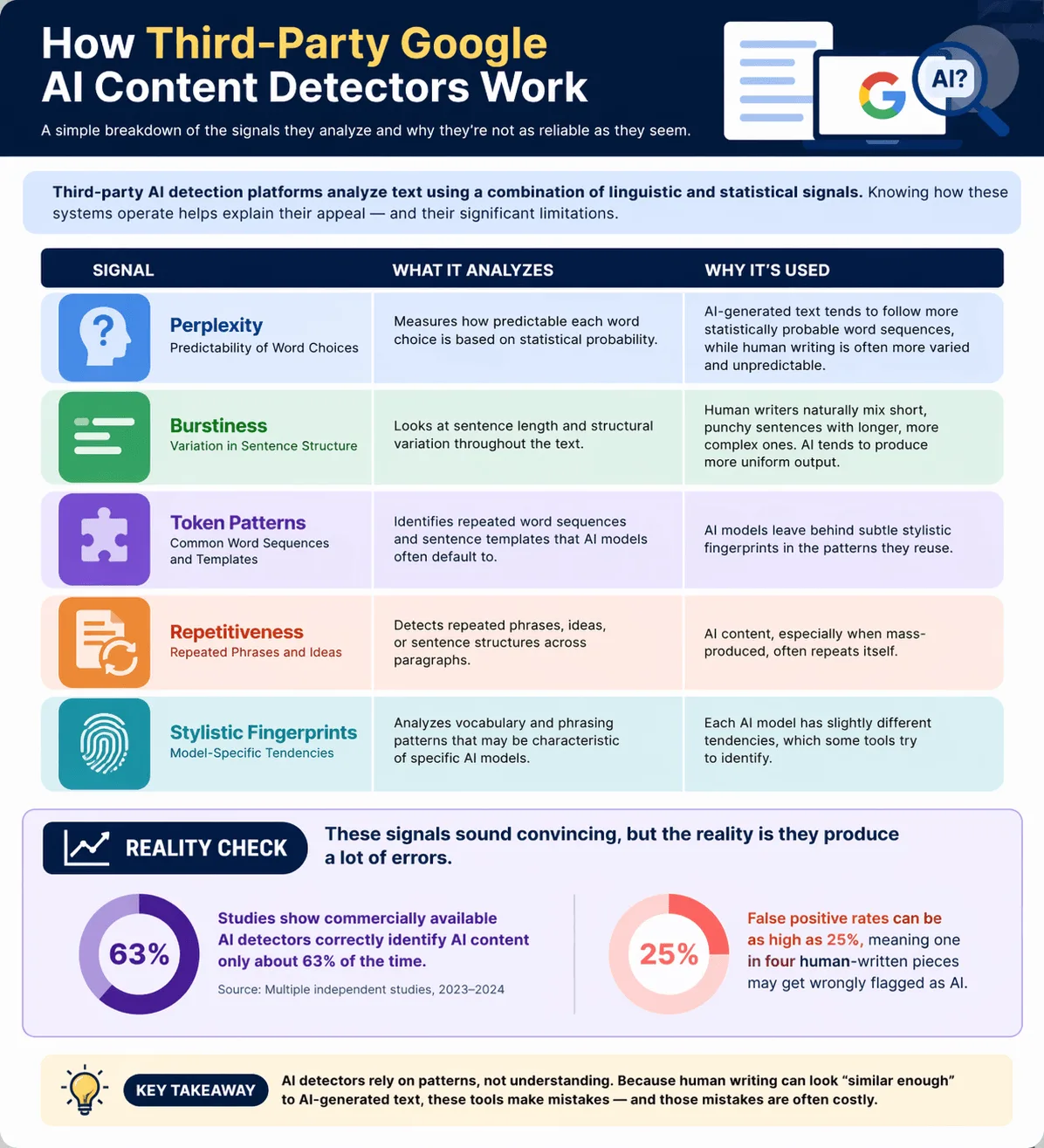
To understand why these tools are unreliable, it helps to know the basic mechanism behind them. Third-party AI detection platforms analyze text using a combination of linguistic and statistical signals. Knowing how these systems operate helps explain both their appeal and their significant limitations.
The most commonly analyzed signals include the following characteristics of written text:
-
- Perplexity — a measure of how predictable each word choice is. AI-generated text tends to follow more statistically probable word sequences, while human writing is often more varied and unpredictable.
- Burstiness — a measure of sentence length and structural variation. Human writers naturally mix short punchy sentences with longer, more complex ones. AI tends to produce more uniform output.
- Token patterns — AI models tend to default to the same common word sequences and sentence templates, leaving behind subtle stylistic fingerprints.
- Repetitiveness — AI content, especially when mass-produced, often repeats similar phrases, ideas, or sentence structures across paragraphs.
- Stylistic fingerprints — each AI model has slightly different tendencies in vocabulary and phrasing, which some tools try to identify.
These signals sound convincing, but the reality is that they produce an alarming number of errors. Studies have shown that commercially available AI detectors correctly identify AI content only approximately 63 percent of the time, with false positive rates reaching as high as 25 percent. That means one in four human-written pieces of content may get flagged as AI-generated by these tools.
Why Third-Party Google AI Content Detectors Fall Short
The limitations of third-party detection tools are well-documented and go well beyond simple error rates. Even the most sophisticated platforms struggle with a range of real-world writing scenarios that expose the inherent weaknesses in their methodology. Several key failure modes have been widely observed and studied.
Perhaps the most famous example of detection failure involves the United States Constitution. Multiple AI detection tools, including GPTZero and Copyleaks, flagged this foundational human-written document as AI-generated. The same misclassification has occurred with passages from the Bible and other historical texts. The reason is simple: formal, structured human writing often exhibits the same low perplexity and high consistency that detectors associate with AI output. When a centuries-old document gets classified as machine-written, it is a clear signal that these tools cannot be trusted as definitive judges of authorship.
Beyond the Constitution example, these tools also systematically struggle with content written by non-native English speakers, academic or formal prose, and any AI content that has been carefully edited by a human. The moment a human editor revises an AI draft — even modestly — the detection accuracy drops significantly. This is not a minor flaw. It goes to the heart of why Google does not use these tools to make ranking decisions.
The bottom line is this: a Google AI content detector in the form of a publicly accessible or algorithmic tool that automatically penalizes content for being AI-generated simply does not exist. What Google does have is something far more sophisticated — and far more focused on quality than origin.
Can Google Detect AI Content? The Real Answer in 2026
The question of whether there is a functional Google AI content detector requires a more precise answer than a simple yes or no. Google has acknowledged that it possesses the technical capability to identify patterns associated with AI-generated text. However, the critical distinction lies in how Google chooses to use that capability — and the answer will likely surprise many small business owners.
According to Google’s official guidance, published through Google Search Central, the company’s position is clear:
“Our focus is on the quality of content, rather than how content is produced.”
Google does not automatically penalize content for being AI-generated. Instead, any Google AI content detector capability that exists is used as a quality assessment tool, not as a trigger for automatic penalties. This is an enormously important distinction that every small business owner needs to understand.
What Google Actually Looks For Instead of AI Authorship
Rather than asking “was this written by AI?“, Google’s algorithms ask a fundamentally different question: “Is this content helpful, original, and trustworthy?” This shift in perspective has major implications for how you should approach your content strategy. Google evaluates a set of quality signals that are entirely independent of who — or what — created the content.
The quality signals that genuinely determine your rankings, regardless of whether any Google AI content detector flags your content, include a consistent set of measurable factors. Understanding these signals is what separates small business owners who rank well from those who do not.
-
- Thin or shallow content — pages that cover a topic superficially without providing real depth or answering user questions thoroughly.
- Generic or repetitive writing — content that feels mass-produced, reuses the same ideas across multiple paragraphs, or fails to add a unique perspective.
- Lack of demonstrated expertise — content that does not show genuine knowledge of a subject or fails to cite credible sources.
- Factual inaccuracies or hallucinated information — a well-known weakness of AI tools that can produce confident-sounding but incorrect claims.
- Keyword stuffing — unnaturally forcing target keywords into content in a way that reads as manipulative rather than helpful.
- Duplicate or near-duplicate content — pages that heavily mirror existing content without adding original value.
- Pages created at scale with no editorial oversight — content that has clearly been mass-produced without any human review or customization.
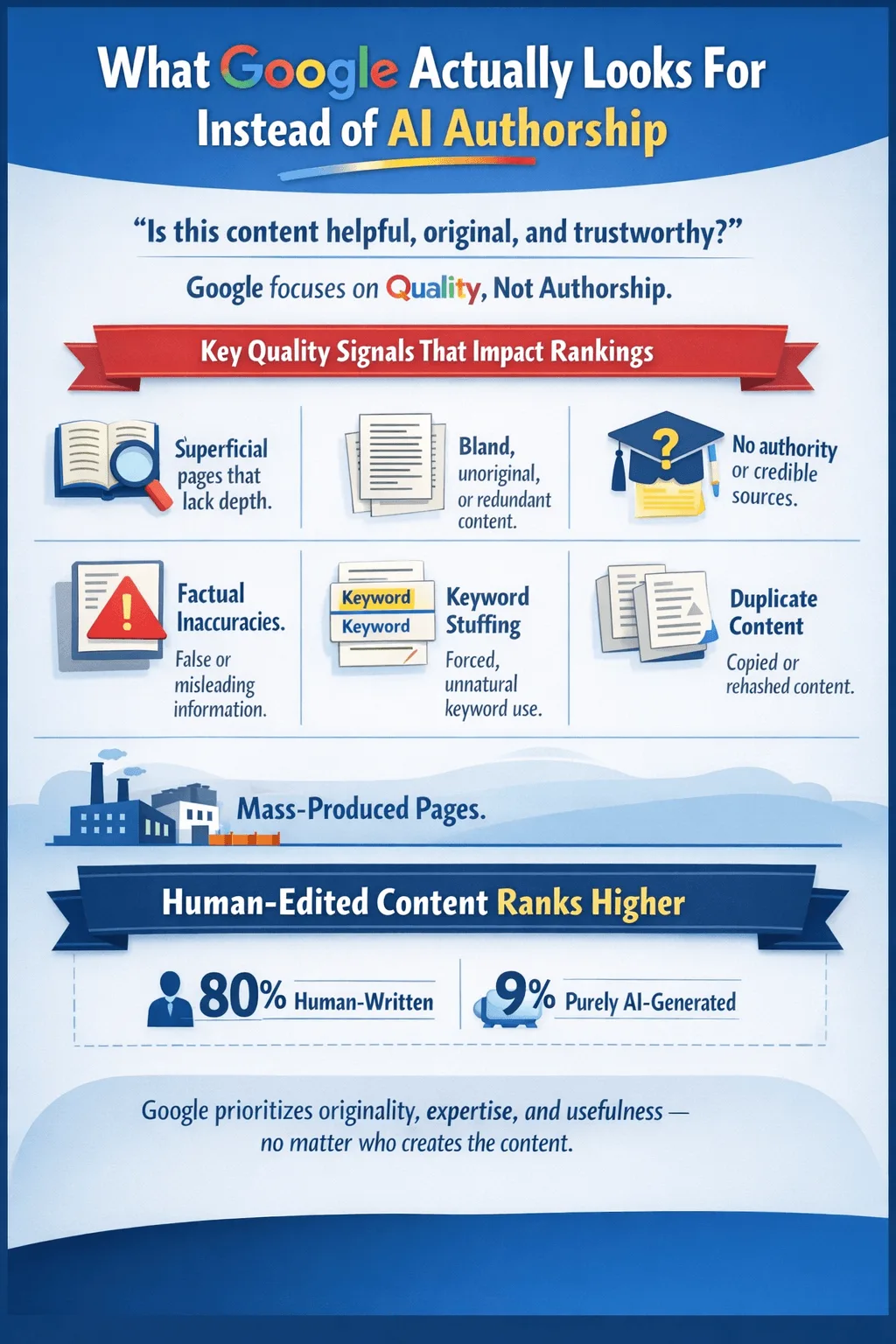
These signals often appear in poorly optimized AI content, which is why people sometimes conclude that Google is “detecting AI.” In reality, Google is detecting low quality — and low quality can be produced by humans just as easily as by machines. A SEMrush analysis of over 42,000 blog posts published in 2026 found that human-written content held the number one position in Google search results approximately 80 percent of the time, compared to just 9 percent for purely AI-generated pages. This is not because Google is punishing AI — it is because human-edited content tends to be more original, more authoritative, and more helpful.
Google’s Official Stance on AI Content in 2026
Google’s position on AI content has evolved meaningfully over recent years, and understanding this evolution is key to removing any lingering fear about the supposed Google AI content detector. The updated guidance from Google Search Central makes clear that “Using automation — including AI — to generate content with the primary purpose of manipulating ranking in search results is a violation of our spam policies. That said, it’s important to recognize that not all use of automation, including AI generation, is spam.”
In practice, this means Google is not concerned with whether you used an AI tool to write your blog post. What Google is concerned with is whether that blog post genuinely helps the person who reads it. If your AI-assisted content provides real value, demonstrates expertise, and is edited to ensure accuracy and originality, Google will reward it — the same way it rewards any high-quality human-written article.
The March 2024 core update and subsequent quality updates have specifically targeted pages that are auto-generated without meaningful effort, research, or human oversight. These updates did not ban AI content. They refined Google’s ability to detect and demote content that lacks originality, depth, and user value — signals that correlate with poor AI usage, not AI usage in general.
How the Google AI Content Detector Conversation Misses the Bigger SEO Picture
Small business owners who spend their energy worrying about bypassing a Google AI content detector are focusing on the wrong problem entirely. The real question is not “how do I hide the fact that my content was written by AI?” The real question is “how do I create content that Google recognizes as authoritative, helpful, and trustworthy enough to rank on page one?” These are fundamentally different problems, and they require very different solutions.
The solution to sustainable search rankings in 2026 is not about outsmarting a detection system. It is about building what SEO professionals call topical authority — a strategy that positions your website as a go-to resource on a specific subject and signals to Google that your site deserves to rank consistently across an entire topic area, not just for a single keyword.
The E-E-A-T Framework: Google’s True Quality Measure
Before diving into topical authority and topical clusters, it is essential to understand the framework that underlies all of Google’s content quality assessments: E-E-A-T, which stands for Experience, Expertise, Authoritativeness, and Trustworthiness. This framework was introduced in Google’s Search Quality Rater Guidelines and serves as the practical standard by which human quality raters — and, by extension, Google’s algorithms — evaluate all content.
E-E-A-T is not a direct ranking factor in the technical sense, but it shapes the algorithms that determine ranking. Here is what each component means for your small business website:
-
- Experience: This refers to whether the content creator has genuine, first-hand knowledge of the subject. For a small business, this might mean sharing real customer case studies, describing your personal process, or including photos of actual work you have done. AI cannot generate authentic lived experience — this has to come from you.
- Expertise: This measures whether the content demonstrates a deep understanding of the subject matter. It includes citing credible sources, referencing industry data, and addressing nuanced subtopics that only someone knowledgeable in the field would know to cover.
- Authoritativeness: This refers to whether your website and brand are recognized by others in your industry. It is strengthened by backlinks from reputable sites, mentions in media coverage, and a consistent publishing history on your core topic.
- Trustworthiness: This is arguably the most important element, covering whether users and Google can rely on your content to be accurate, honest, and transparent. It includes having a secure website, clear contact information, and properly cited sources.
The good news for small business owners is that E-E-A-T is not reserved for large corporations or established publications. A well-structured local plumbing company, an independent accountant, or a boutique marketing agency can all demonstrate strong E-E-A-T through consistent, well-edited content that reflects their genuine expertise. Even content initially drafted with an AI tool can fully satisfy E-E-A-T requirements — as long as it is human-reviewed, factually accurate, and enriched with original insights.
Topical Authority: The Strategy That Beats Any Google AI Content Detector Concern
If worrying about the Google AI content detector is the wrong problem to solve, then topical authority is the right strategy to embrace. Topical authority is one of the most powerful and durable SEO approaches available to small business owners in 2026, and it works regardless of whether your content is written by a human, an AI tool, or a combination of both.
What Is Topical Authority?
Topical authority refers to how comprehensively and consistently your website covers a specific subject area. When Google’s algorithms recognize that your website thoroughly addresses all the key questions and subtopics within a given niche, they begin to treat your site as an authoritative resource — rewarding it with higher rankings across all the content you publish within that topic.
Think of topical authority like earning a professional reputation in your community. If you are a financial advisor who has consistently spoken at local events, published detailed guides on retirement planning, savings strategies, and tax minimization, and answered hundreds of client questions over the years, people in your community recognize you as the go-to expert on personal finance. Google works similarly. The more comprehensively and consistently you cover a subject on your website, the more Google trusts your site as an authoritative source on that subject.
According to research published in 2026, pages with high topical authority gain meaningful traffic nearly twenty days faster than those with low topical authority. Furthermore, sites that build at least 25 to 30 high-quality, interlinked articles within a single content cluster see ranking gains up to three times faster than sites that pursue scattered keyword-based strategies. These are significant advantages for any small business looking to grow its online presence without a massive marketing budget.
Why Topical Authority Outperforms Traditional Keyword-Based SEO
For years, SEO strategy was built around individual keywords. You would identify a high-volume search term, write a single article targeting it, and hope to rank. This approach worked reasonably well in the early days of search, but Google’s algorithms have become far too sophisticated for it to deliver reliable, sustained results in 2026.
Today, Google evaluates your entire website — not just individual pages — when determining how much authority to assign to any given piece of content. A site with 20 thoughtfully interconnected articles on a specific topic will consistently outrank a site with a single outstanding article on that same topic, even if the single article is technically superior in isolation. This is the power of topical authority, and it is why small business owners who invest in building it tend to see compounding results over time.
There are several concrete reasons why topical authority delivers better long-term results than traditional keyword targeting. Each of these reasons directly supports the kind of sustainable growth that small business owners need:
-
- Content organized into clusters drives approximately 30 percent more organic traffic and holds rankings up to 2.5 times longer than standalone posts, according to SEO research published in 2026.
- A website with strong topical authority in a specific niche can outrank established sites with significantly higher domain authority, making it a viable strategy for small businesses competing against larger brands.
- Topical authority results in compounding returns — as your cluster grows, older pages gain stability and new pages rank faster because they benefit from the established authority of the entire cluster.
- Once Google recognizes your website as an authority on a subject, it often begins ranking your content for related keywords you never explicitly targeted, dramatically expanding your organic reach.
These advantages make topical authority not just a theoretical SEO concept but a practical, measurable strategy that delivers real business results. For a small business owner who does not have the time to chase individual keywords or manage complex technical SEO, building a well-structured topical cluster is one of the most efficient investments you can make in your online presence.
How Topical Clusters Work: The Pillar and Cluster Model
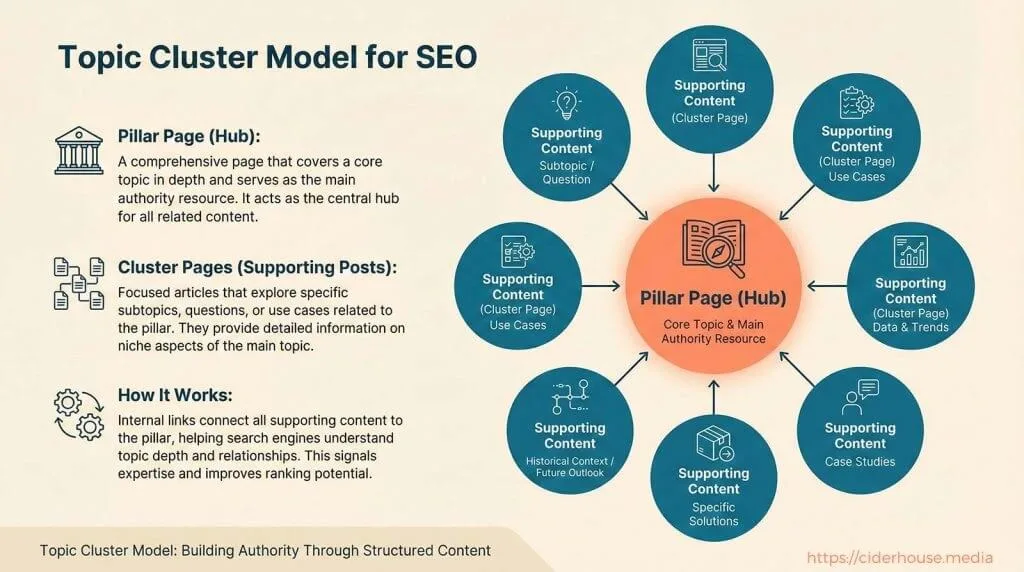
Topical authority is built through a content architecture called the pillar-and-cluster model. This structure organizes your content into two distinct but interconnected types of pages, each playing a specific role in establishing your authority and supporting your search rankings.
Understanding this model is straightforward, even if you have no prior SEO experience. Here is how the two components work together:
-
- The Pillar Page: This is your comprehensive, long-form guide on a broad topic — the centerpiece of your content cluster. A pillar page typically ranges from 3,000 to 5,000 words and covers the main topic in enough depth to serve as a definitive reference. It links outward to all the cluster content that supports it. For example, this article could serve as a pillar page for the topic of AI content and Google rankings, covering the concept of the Google AI content detector, topical authority, and content strategy in a single comprehensive resource.
- Cluster Pages: These are the focused, deep-dive articles that explore specific subtopics within the broader pillar topic. Each cluster page targets a more specific question or keyword, provides thorough coverage of that narrow subject, and links back to the pillar page. Cluster pages are what allow your website to answer every question a potential customer might have about a subject — signaling to Google that your site offers comprehensive topical coverage.
Internal linking is the critical element that transforms a collection of individual articles into a functioning content cluster. Every cluster page should link back to the pillar page using anchor text that includes the pillar’s target keyword, and the pillar page should link out to every cluster page. This bidirectional linking structure distributes authority throughout the cluster, helps search engine crawlers understand the hierarchy of your content, and creates a seamless navigation experience for human readers.
Building a Topical Cluster Around the Google AI Content Detector Topic
One of the most strategic things a business like WebsiteContentWriters.org can do is build a full topical cluster around the subject of AI content, Google’s quality systems, and the Google AI content detector concept. This topic is not just highly searched — it is highly relevant to the exact audience of small business owners, bloggers, and agencies who are trying to understand how to use AI writing tools safely and effectively.
A well-constructed topical cluster on this subject could anchor an entire content marketing strategy, attracting organic traffic from dozens of related search terms while simultaneously building the domain authority needed to compete in broader AI and SEO-related topics over time.
Your Pillar Page: The Google AI Content Detector Overview
This article itself is an example of a pillar page. It covers the concept of the Google AI content detector comprehensively — addressing what it is (and is not), how Google actually evaluates AI content, the E-E-A-T framework, topical authority strategy, how to build content clusters, and actionable steps for ranking blog posts. A pillar page like this can rank for dozens of variations of its core keyword while also supporting the cluster pages that link back to it.
A strong pillar page does not just answer one question — it anticipates every question a reader might have about the topic and addresses them all in one place. This comprehensiveness is what signals to Google that the page — and by extension, the entire website — deserves to be treated as an authoritative resource on this subject.
Cluster Content Ideas for the Google AI Content Detector Topic
Around this pillar page, a complete topical cluster for the Google AI content detector subject area would include a range of supporting articles, each targeting a specific related question or subtopic. These cluster pages work together to signal comprehensive topical coverage to Google, attracting visitors from many different search queries.
The following cluster content ideas represent the most strategically valuable subtopics to cover within this niche. Each one targets a distinct user intent and audience segment, collectively covering the full breadth of the topic.
-
- What is AI content detection? A beginner’s guide for small business owners
- How Google evaluates AI-generated blog posts in 2026
- The best AI content detectors — and why they are unreliable
- How to humanize AI content so it reads naturally and ranks well
- How to avoid Google penalties when using AI writing tools
- The future of AI in SEO — what small businesses need to know
- AI writing versus human writing — a practical comparison for bloggers
- How to use AI safely for small business content creation
- E-E-A-T explained: how to demonstrate authority in AI-assisted content
- How to build a content strategy with AI tools on a small business budget
Each of these cluster articles serves a dual purpose. First, it captures organic traffic from the specific search queries that users type into Google when seeking information on that subtopic. Second, it reinforces the topical authority of the pillar page by linking back to it and signaling to Google’s algorithms that your website offers comprehensive coverage of the entire Google AI content detector topic ecosystem.
How to Create Blog Posts That Enhance Topical Authority
Now that you understand the theory behind topical authority and topical clusters, it is time to get practical. Many small business owners know they need to publish blog content regularly, but they publish articles sporadically, on unrelated topics, without any connecting structure — and then wonder why their rankings remain flat. The following framework provides a step-by-step approach to creating blog posts that systematically build topical authority and drive sustainable organic traffic.
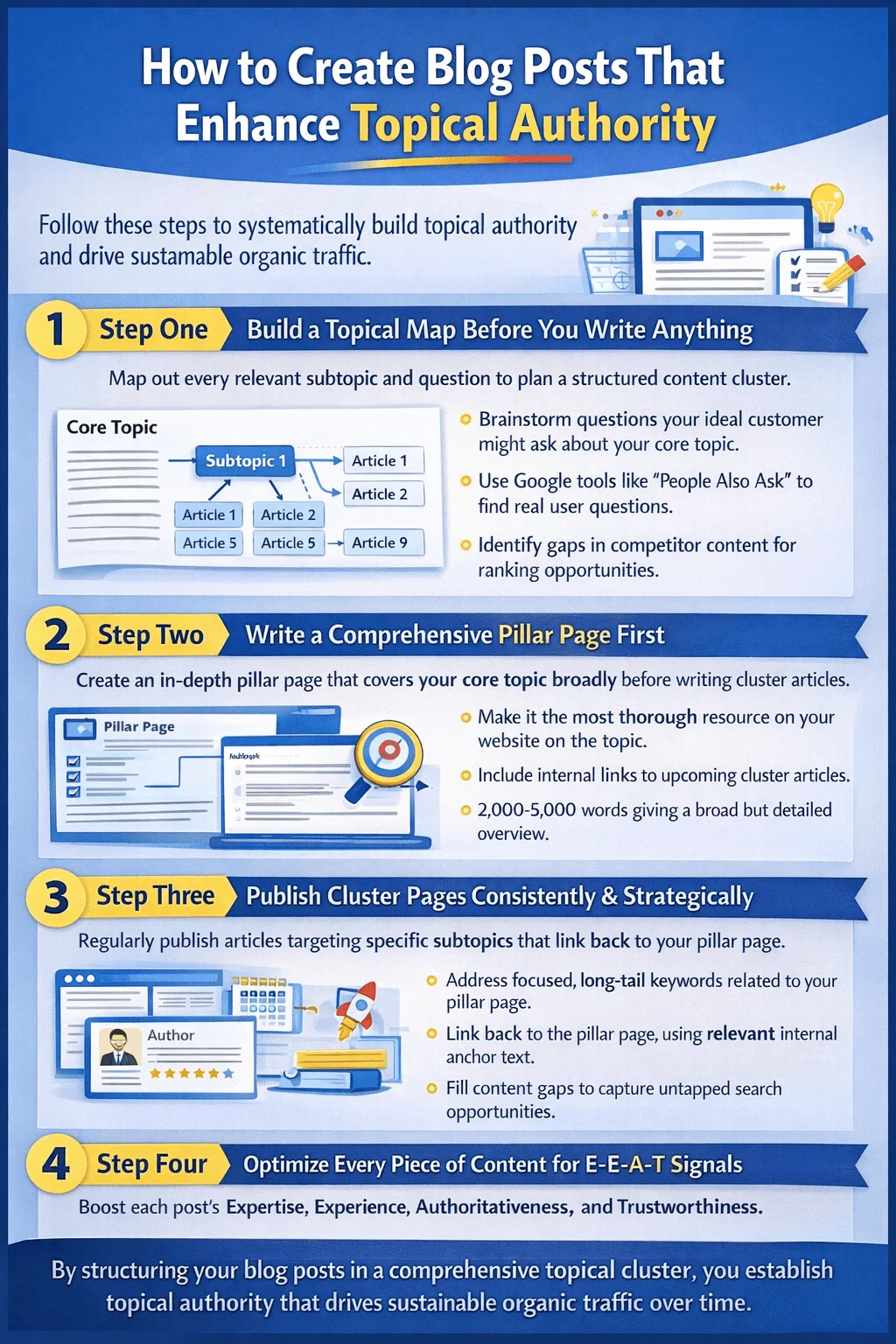
Step One: Build a Topical Map Before You Write Anything
The single most important thing you can do before publishing any content is to create a topical map. A topical map is a planned outline of every subtopic and question related to your core subject. It acts as a blueprint that ensures your content cluster covers the topic comprehensively — from broad overview content down to highly specific, long-tail subtopics.
Creating a topical map does not require expensive tools or advanced SEO knowledge. The process involves a few straightforward research steps that any small business owner can complete in an afternoon. Here is how to approach it:
-
-
-
- Start with your core topic and brainstorm every question your ideal customer might ask about it. Write down everything, even if it seems too basic or too specific.
- Use Google’s “People Also Ask” boxes and the “Related Searches“ section at the bottom of search results pages to discover the exact questions real users are typing into Google.
- Look at what your competitors are publishing. Identify which subtopics they are covering, and — more importantly — which gaps they are leaving unfilled. Those gaps represent your biggest ranking opportunities.
- Organize your questions and subtopics into a hierarchy: broad overview topics at the top, specific deep-dive questions below. This hierarchy becomes the blueprint for your pillar page and cluster articles.
- Prioritize your cluster content based on search volume, competition, and relevance to your business. Focus first on subtopics where your expertise is strongest and competition is most manageable.
-
-
Once you have your topical map, you have a content calendar that will serve you for months. Rather than staring at a blank screen each week wondering what to write about, you have a structured plan that systematically builds your authority on the subject — one cluster page at a time.
Step Two: Write a Comprehensive Pillar Page First
Your pillar page is the foundation of your entire content cluster. It should be the most comprehensive resource on your website about the core topic — covering every major aspect at an overview level while linking out to the more detailed cluster articles for readers who want to dive deeper into specific subtopics. Pillar pages generally range from 3,000 to 5,000 words and serve as the canonical authority on the subject within your site.
A well-written pillar page does several things simultaneously. It ranks for the broad, high-volume keywords associated with the core topic. It provides an internal linking hub that distributes authority to your cluster pages. And it serves as a first point of contact for new visitors who arrive at your site from search, giving them a comprehensive introduction to your expertise before guiding them deeper into your content.
When writing your pillar page, keep these principles in mind. They apply whether you are writing the content yourself, using an AI writing tool, or working with a content creation service.
-
-
-
- Cover the topic broadly but not superficially — the goal is comprehensive overview, not encyclopedic depth on every subtopic.
- Use clear heading structure (H1, H2, H3) that reflects the logical hierarchy of the topic and includes your target keyword naturally in key headings.
- Include a table of contents or clear navigation so readers can jump to the sections most relevant to their needs.
- Add internal links to every cluster article as you publish them, keeping the pillar page updated as new content is added to your cluster.
- Include original insights, data, or real-world examples that demonstrate your first-hand expertise — elements that AI alone cannot generate.
-
-
A pillar page that is well-structured, genuinely helpful, and enriched with original perspective will naturally satisfy Google’s E-E-A-T requirements and establish the topical foundation that your entire cluster builds upon.
Step Three: Publish Cluster Pages Consistently and Strategically
Once your pillar page is live, your primary task is to systematically publish the cluster articles that surround and support it. Consistency is more important than volume here. A single high-quality cluster article published each week will build topical authority far more effectively than a burst of thin articles followed by months of silence.
Each cluster page should follow a specific structure that maximizes both its individual ranking potential and its contribution to the broader topical cluster. The following structural elements should be present in every cluster article you publish.
-
-
-
- A clear, keyword-optimized title that directly addresses the specific question or subtopic the article covers.
- An engaging introduction that explains exactly what the reader will learn and why it matters to them personally.
- A logical heading structure that breaks the content into clearly delineated sections, with the primary and secondary keywords appearing naturally in key headings.
- Original insights, examples, or data that go beyond what can be found in existing articles on the same topic — this is what earns E-E-A-T signals.
- A strong internal link back to the pillar page, using descriptive anchor text that includes the pillar’s primary keyword.
- Additional internal links to two or three closely related cluster articles where contextually appropriate.
- A call to action that moves the reader to the next logical step — whether that is reading another article, contacting your business, or signing up for a service.
-
-
Over time, as your cluster grows and Google’s crawlers index the interconnected web of content you are building, you will notice that your rankings begin to stabilize and expand. Pages within a well-structured cluster tend to rank for dozens of keyword variations beyond the primary target — a compounding effect that makes topical authority one of the highest-return content investments a small business can make.
Step Four: Optimize Every Piece of Content for E-E-A-T Signals
Building topical authority through a cluster structure is necessary but not sufficient on its own. Every piece of content within your cluster — pillar page and cluster articles alike — needs to actively demonstrate the E-E-A-T signals that Google uses to assess quality. For small business owners, this means going beyond what an AI writing tool can produce on its own and adding the human elements that transform a generic draft into a genuinely authoritative piece of content.
The following E-E-A-T optimization steps should be applied to every blog post before it is published. These steps are equally applicable whether you write content from scratch, use an AI tool to generate a first draft, or work with a writing service.
-
-
-
- Add an author bio that lists your qualifications, years of experience, and relevant credentials. A named, credentialed author is a strong trust signal that improves your content’s perceived authority.
- Cite authoritative external sources — industry studies, government data, reputable publications — to back up key claims. This demonstrates expertise and builds trust.
- Include real examples, case studies, or customer stories that could only come from someone with genuine experience in the field. These are the elements that separate authoritative content from generic information.
- Keep your content updated. An article published in 2024 that is updated in 2026 with current data and fresh insights signals to Google that your content is actively maintained and trustworthy.
- Display positive customer reviews, testimonials, or case study results near relevant content to reinforce your reputation and authority.
-
-
These E-E-A-T elements are not optional extras — they are the difference between content that ranks for a few weeks before dropping off and content that holds its position and continues to attract organic traffic for months or years.
The Hybrid Approach: AI Plus Human Editing for Maximum SEO Impact
The most effective content strategy for small business owners in 2026 is not to choose between AI and human writing — it is to combine them intelligently. The so-called hybrid approach, where AI generates a structured first draft and a human editor refines it for quality, originality, and brand voice, consistently outperforms both pure AI output and time-intensive manual writing in terms of both efficiency and SEO performance. This is why any discussion of the Google AI content detector should ultimately arrive at this conclusion: the question is not whether you use AI, but how well you use it.
How to Use AI Without Triggering Google’s Quality Signals
Using AI tools responsibly means understanding what they do well and where they fall short. AI writing tools are exceptional at generating structured outlines, producing coherent first drafts on well-documented topics, suggesting keyword usage, and accelerating the research and drafting process. They are poor at generating genuine first-hand experience, producing truly original insights, catching their own factual errors, and adapting naturally to a unique brand voice.
When you understand this division of strengths, the optimal workflow becomes clear. Let AI handle the parts of content creation it is genuinely good at — and invest your human effort where it matters most. The following workflow represents the best practice approach that consistently produces content which ranks well and satisfies Google’s quality systems without triggering any negative signals.
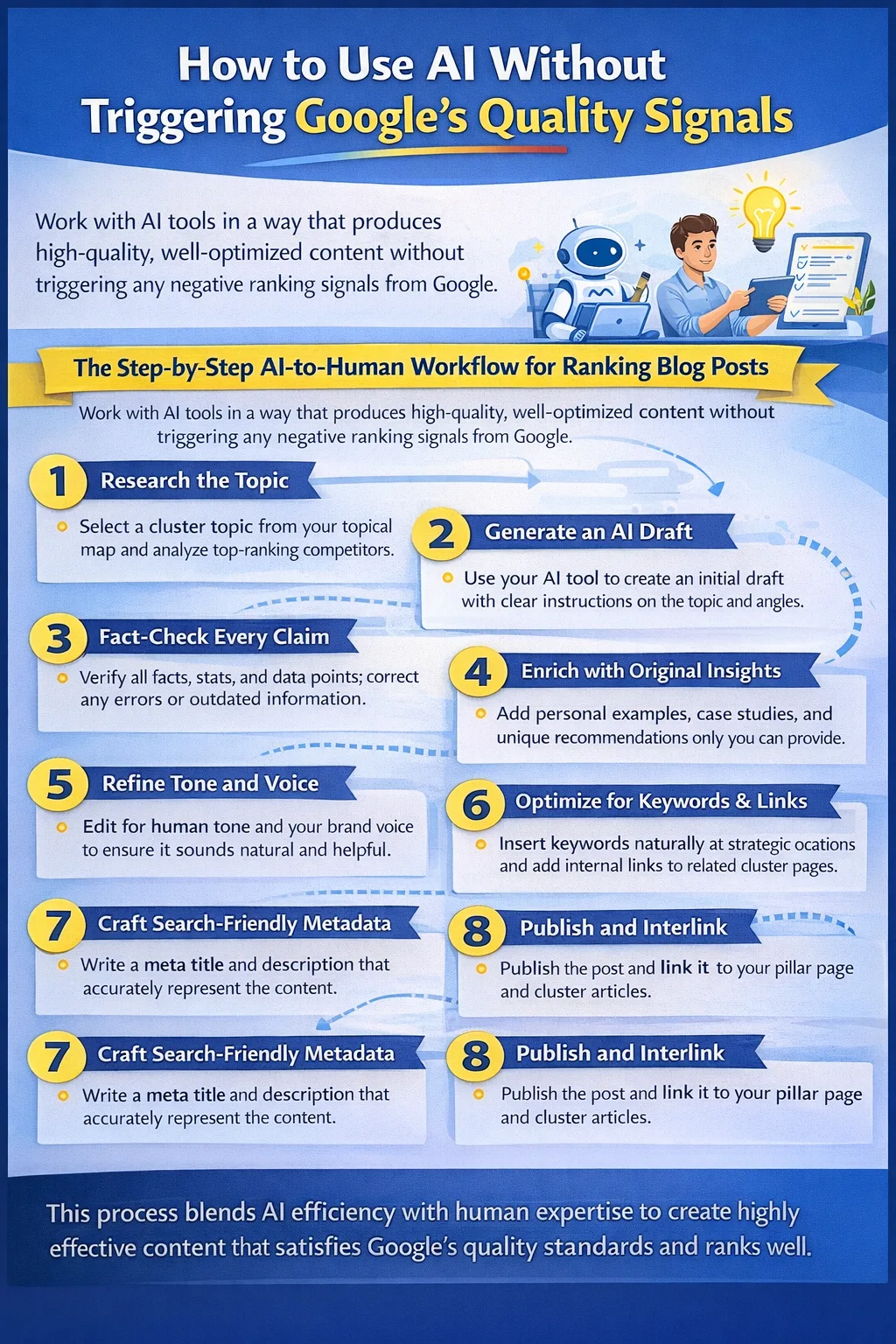
The Step-by-Step AI-to-Human Workflow for Ranking Blog Posts
Following a structured workflow for every piece of content you publish ensures consistent quality and systematic topical authority building. Each step in this workflow addresses a specific aspect of what Google rewards and what it penalizes. When followed consistently, this process produces content that performs well from the first month of publication and continues to build authority over time.
-
- Select a cluster topic from your topical map and conduct a quick search to understand what top-ranking competitors are currently publishing on that subtopic.
- Use your AI writing tool to generate a structured first draft, providing it with clear instructions about your target keyword, the specific question being answered, and any unique angles or examples you want included.
- Review the draft critically and fact-check every specific claim, statistic, or data point. AI tools are prone to hallucination — they can produce confident-sounding information that is inaccurate or outdated.
- Enrich the draft with original elements that only you can provide: a real customer example from your business, a personal observation about your industry, a specific recommendation based on your professional experience, or a data point from your own operations.
- Edit the content for tone and brand voice, ensuring it sounds like it was written by a knowledgeable human being who genuinely cares about helping the reader — not by a language model optimizing for keyword density.
- Add the keyword naturally to the H1 title, at least two H2 or H3 subheadings, the meta description, the first paragraph, and throughout the body at a comfortable, readable density.
- Include two to four internal links to related articles within your cluster, with descriptive anchor text that helps both readers and search engines understand the relationship between the pages.
- Add a compelling meta title and meta description that accurately represent the content and include the target keyword naturally.
- Publish the article and add it to your pillar page’s internal linking structure.
This workflow does not require a large team or technical SEO expertise. A small business owner who dedicates two to three hours per week to this process can build a meaningful topical cluster within three to six months — and begin seeing measurable ranking improvements within that same timeframe.
AI Content vs. Human Content vs. Hybrid Content: A Practical Comparison
To make the right decision for your business, it helps to see a clear comparison of the three primary content creation approaches. This table illustrates exactly where each method excels, where it falls short, and what the implications are for your SEO strategy and overall content quality.
| Feature | AI-Generated Only | Human-Written Only | Hybrid (AI + Human) |
| Speed | Very fast | Slow | Fast |
| Cost | Low | High | Low to Medium |
| Accuracy | Sometimes inaccurate | High with research | Very high with fact-checking |
| Originality | Medium | High | High |
| E-E-A-T Signals | Low without editing | High | High with human input |
| SEO Performance | Medium — often drops after updates | High | Very high — most resilient |
| Tone and Brand Voice | Generic | Strong | Strong with editing |
| Topical Authority Building | Weak without strategy | Strong | Very strong with cluster structure |
| Best Use Case | First drafts only | Expert-level content | SEO content, blogs, cluster articles |
| Risk Level | Medium — vulnerable to quality updates | Low | Very low |
The hybrid approach delivers the best results across every dimension because it combines the efficiency of AI with the originality, expertise, and quality control of human oversight. For small business owners who are short on time but need consistent, high-quality content to build topical authority, this approach represents the best available option in 2026.
Pre-Publication Checklist: How to Make Every Blog Post Rank-Ready
Before you publish any article — whether it was written by an AI tool, a human writer, or a combination of both — it should pass through a quality checklist that ensures it is properly optimized for Google and genuinely useful for your readers. This checklist applies to every piece of content in your topical cluster, from the pillar page down to the most specific cluster article.
Use the following checklist consistently before hitting publish. Each item addresses a specific quality or optimization factor that directly influences how your content performs in search.
-
- The primary keyword appears naturally in the H1 title, at least two subheadings, the introduction, and throughout the body.
- The content has been fact-checked and all statistics, claims, and data points are verified against credible, up-to-date sources.
- Original insights, examples, or first-hand experience have been added that could not be found in any competing article.
- Generic or repetitive sentences have been identified and rewritten to add specific value or unique perspective.
- The tone and voice are consistent with your brand and sound genuinely human, not robotic or formulaic.
- At least two to four internal links connect this article to related cluster pages, using descriptive anchor text.
- At least one or two external links point to credible, authoritative sources that support key claims.
- An author bio is included that lists relevant qualifications or experience.
- The meta title and meta description include the target keyword and accurately represent the content in a compelling way.
- Images or visual elements are included and properly optimized with descriptive alt text.
- The article includes a clear call to action that guides the reader to the next step.
- The introduction hooks the reader within the first two sentences and clearly establishes the value of reading the full article.
- The conclusion summarizes the key takeaways and reinforces the primary message without introducing new information.
This checklist takes fewer than fifteen minutes to complete once you have internalized the standards it represents. Making it a non-negotiable part of your publishing process ensures that every article you add to your topical cluster meets the quality threshold that Google rewards — regardless of how it was created.
Sample Topical Map: Building Authority Around the Google AI Content Detector Topic
The following table illustrates how a complete topical map might be structured for a website looking to build authority around the Google AI content detector topic. Each row represents a distinct piece of content, its target keyword, its content type, and its role within the cluster. This table can serve as a practical template for planning your own topical cluster, adapted to your specific industry and audience.
| Content Type | Target Keyword / Topic | Role in Cluster | Approx. Word Count |
| Pillar Page | Google AI content detector — complete guide | Hub page; links to all cluster articles | 4,000–5,000 |
| Cluster Article | What is AI content detection? | Foundational explainer; links to pillar | 1,200–1,800 |
| Cluster Article | How Google evaluates AI-generated content | Deep dive on quality signals; links to pillar | 1,500–2,000 |
| Cluster Article | Best AI content detectors compared | Tool comparison; links to pillar | 1,500–2,000 |
| Cluster Article | How to humanize AI content for SEO | Practical how-to; links to pillar | 1,200–1,800 |
| Cluster Article | How to avoid Google penalties for AI content | Risk management guide; links to pillar | 1,200–1,800 |
| Cluster Article | E-E-A-T and AI content: small business guide | Framework explainer; links to pillar | 1,500–2,000 |
| Cluster Article | AI writing tools for small business SEO | Tool overview; links to pillar | 1,500–2,000 |
| Cluster Article | How to build a content cluster on a budget | Strategy guide; links to pillar | 1,500–2,000 |
| Cluster Article | Future of AI in Google search 2026 | Trend article; links to pillar | 1,200–1,800 |
A completed topical map like this one gives your content strategy a clear roadmap that can be executed systematically over weeks and months. Each article you publish adds to the cumulative authority of your cluster, and the internal linking structure ensures that Google’s crawlers can navigate the full depth of your topical coverage with ease.
Final Thoughts: Stop Fearing the Google AI Content Detector and Start Building Authority
The fear around the Google AI content detector is understandable, but it is ultimately misdirected. Google does not punish AI content. Google rewards helpful, original, well-structured content — and it has sophisticated systems for identifying everything that falls short of that standard, regardless of whether a human or a machine wrote it.
For small business owners, this is genuinely good news. It means that you do not need to abandon AI writing tools or pretend they do not exist. You do not need to trick a Google AI content detector or hide the fact that you used technology to assist your content creation. What you do need is a smart, intentional strategy for creating content that Google recognizes as authoritative, helpful, and trustworthy — and that strategy is topical authority.
By building a well-structured topical cluster around the subjects most relevant to your business, publishing consistently, linking your content strategically, and enriching every article with the genuine human expertise that only you can provide, you can achieve the kind of sustainable search rankings that no algorithm update can easily disrupt.
The small business owners who thrive in search in 2026 and beyond will not be the ones who found the cleverest way to fool a detection system. They will be the ones who built genuine topical authority — the ones who became the go-to resource in their niche, one helpful article at a time.
If you do not have the time or know-how to build this content strategy on your own, WebsiteContentWriters.org exists precisely to help. The platform combines the speed of AI-assisted drafting with the quality of professional human editing, producing SEO-optimized content that is structured for topical authority, aligned with Google’s E-E-A-T standards, and ready to publish — so you can focus on running your business while your content builds your online authority.
Frequently Asked Questions About the Google AI Content Detector
Here are a few frequently asked questions on the topic of “Google AI content detector”:
Does Google actually have an AI content detector that penalizes websites?
This is the most common question surrounding the Google AI content detector topic, and the answer requires some important nuance. Google has acknowledged that it possesses technical systems capable of identifying patterns in AI-generated text. However, those systems are designed for quality assessment purposes — not for automatic penalization of all AI content. Google’s own official guidance from Google Search Central explicitly states that AI content is not inherently against its policies. What Google penalizes is content that is unhelpful, unoriginal, mass-produced without meaningful editorial oversight, or created primarily to manipulate search rankings rather than to serve readers.
This means that the fear of a hidden Google AI content detector that automatically demotes AI-written content is not supported by Google’s published guidance or by SEO industry research. A Semrush analysis from 2026 confirmed that high-quality AI-assisted content can and does appear in top-ten search results. The decisive factor is not AI authorship — it is content quality, demonstrated expertise, and alignment with what users are genuinely searching for. A well-edited, factually accurate, and uniquely valuable article produced with the help of an AI writing tool has every opportunity to rank just as well as a purely human-written article on the same subject.
How can I make my AI-assisted blog posts rank well without worrying about a Google AI content detector?
The most effective approach to ranking AI-assisted content well is to stop thinking about the Google AI content detector altogether and start focusing on the quality signals that Google actually uses to evaluate content. Those signals are captured in the E-E-A-T framework — Experience, Expertise, Authoritativeness, and Trustworthiness — and they are entirely within your control regardless of which tools you use to create content.
Begin by using AI writing tools only for the tasks they do well: generating structured outlines, producing first drafts, and suggesting keyword usage. Once you have a draft, invest your human effort in the areas where AI falls short: adding first-hand examples from your business experience, fact-checking every specific claim, rewriting sections that sound generic or formulaic, and ensuring the final article reflects your genuine brand voice. Beyond the individual article level, build a topical cluster strategy that organizes your content around a core pillar page, supported by interlinked cluster articles that cover every relevant subtopic within your niche. This structure signals to Google that your site is a comprehensive authority on the subject — which is the single most powerful way to achieve sustainable rankings in 2026.
Topical authority refers to how comprehensively and consistently your website covers a specific subject area. When Google’s algorithms recognize that your site thoroughly addresses all the key questions within a given topic — through a well-structured collection of interlinked pillar and cluster content — they treat your site as an authoritative resource and reward it with higher rankings across all the content within that topic. Topical authority matters more than any concern about a Google AI content detector because it directly addresses what Google actually rewards: genuine expertise, comprehensive coverage, and consistent helpfulness.
Research published in 2026 shows that sites with strong topical authority in specific niches can outrank established sites with significantly higher domain authority. Content organized into well-structured clusters drives approximately 30 percent more organic traffic and holds rankings up to 2.5 times longer than standalone articles targeting individual keywords. For small business owners, topical authority is the most accessible and most durable SEO strategy available — one that delivers compounding returns over time, requires no technical expertise to implement, and is equally compatible with human-written content, AI-assisted content, and the hybrid approach that most experts recommend.
Are third-party AI content detectors accurate, and should I use them before publishing?
Third-party AI content detectors are not reliably accurate, and using them as the primary quality gate before publishing your content is not recommended. Studies have shown that these tools correctly identify AI content only approximately 63 percent of the time, with false positive rates reaching as high as 25 percent. The most famous example of this unreliability is the fact that multiple prominent detection platforms flagged the United States Constitution — a document written centuries before the existence of AI — as machine-generated. Similar misclassifications have occurred with passages from historical religious texts and other formal human writing. The underlying reason is that these tools analyze statistical patterns in language that can appear in both AI output and formal human prose, making them inherently unable to serve as definitive arbiters of authorship.
Since Google itself does not rely on these third-party tools for ranking or penalization decisions, running your content through a Google AI content detector platform before publishing adds no meaningful protection and can create unnecessary anxiety based on unreliable results. The far better approach is to run your content through the E-E-A-T checklist outlined in this article — ensuring it is factually accurate, enriched with original insights, properly attributed, and written in a clear and helpful tone. Content that passes that human editorial standard will perform well in search regardless of what any AI detection tool says about it.
How long does it take to see results from a topical cluster strategy?
The timeline for seeing meaningful results from a topical cluster strategy varies depending on your domain’s existing authority, the competitiveness of your target niche, and the pace at which you publish new cluster content. That said, industry research and practitioner case studies provide useful general benchmarks that can help set realistic expectations.
For websites implementing a pillar-and-cluster strategy for the first time, early ranking gains typically appear within three to six months, primarily from cluster pages targeting long-tail keywords with lower competition. The pillar page builds authority more gradually, often showing meaningful ranking improvements between six and twelve months after the initial cluster is established. Websites that sustain consistent cluster publishing for twelve or more months typically see organic traffic increases of 40 percent or more compared to sites using isolated keyword-based strategies. For small businesses competing in moderately competitive niches, achieving a full topical cluster of 20 to 30 interconnected articles is the threshold at which authority begins to compound noticeably — a goal that is entirely achievable within six to nine months of consistent, weekly publishing.
Ready to Build Your Topical Authority Without Writing Every Word Yourself?
WebsiteContentWriters.org provides AI-powered, human-edited SEO blog content designed specifically for small business owners who want to rank on Google without spending hours each week writing. From pillar page creation to full topical cluster development, the platform delivers publish-ready content that is keyword-optimized, E-E-A-T-aligned, and structured for long-term authority building. Visit WebsiteContentWriters.org to generate your first free SEO blog post today.